
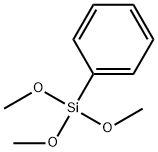
Phenyltrimethoxysilane; PTMS (CAS#2996-92-1)
| Risk Codes | R10 - Flammable R36/37/38 - Irritating to eyes, respiratory system and skin. R68/20/21/22 - R20/21/22 - Harmful by inhalation, in contact with skin and if swallowed. R14 - Reacts violently with water |
| Safety Description | S7 - Keep container tightly closed. S16 - Keep away from sources of ignition. S26 - In case of contact with eyes, rinse immediately with plenty of water and seek medical advice. S36/37 - Wear suitable protective clothing and gloves. S45 - In case of accident or if you feel unwell, seek medical advice immediately (show the label whenever possible.) S37/39 - Wear suitable gloves and eye/face protection S36 - Wear suitable protective clothing. |
| UN IDs | UN 1992 3/PG 3 |
| WGK Germany | 3 |
| RTECS | VV5252000 |
| FLUKA BRAND F CODES | 10-21 |
| TSCA | Yes |
| HS Code | 29319090 |
| Hazard Class | 3.2 |
| Packing Group | III |
Introduction
Phenyltrimethoxysilane is an organosilicon compound. The following is an introduction to the properties, uses, preparation methods and safety information of phenyltrimethoxysilanes:
Quality:
- Appearance: Phenyltrimethoxysilane is a colorless liquid.
- Solubility: soluble in non-polar organic solvents, such as methylene chloride, petroleum ether, etc.
- Stability: Stable at room temperature, but has the potential to decompose in direct sunlight.
Use:
Phenyltrimethoxysilane is widely used in the field of organic synthesis and surface modification, and the specific uses are as follows:
- Catalyst: It can be used as a catalyst for Lewis acid to promote organic reactions.
- Functional materials: can be used to prepare polymer materials, coatings, adhesives, etc.
Method:
Phenyltrimethoxysilane can be prepared by:
Phenyltrichlorosilane is reacted with methanol to form phenyltrimethoxysilane and hydrogen chloride gas is generated:
C6H5SiCl3 + 3CH3OH → C6H5Si(OCH3)3 + 3HCl
Safety Information:
- In case of contact with skin or eyes, rinse immediately with plenty of water and seek medical attention.
- Avoid inhaling vapors and use in a well-ventilated area.
- Avoid contact with oxidants and acids when storing.
- Wear appropriate personal protective equipment (PPE) such as safety glasses, gloves, etc. when in use.
Application
Phenyltrimethoxysilane (PTMS, CAS 2996-92-1) is a phenyl-functional organosilane that combines the thermal and UV stability of an aromatic ring with the reactivity of three methoxy groups. Its three reactive sites enable it to form a dense, cross-linked network, making it a versatile crosslinking agent for silicone resins, organic resins, coatings, sealants, and adhesives. As a surface modifier and dispersion agent, PTMS improves the wettability and dispersibility of mineral-filled polymers, including treatments for inorganic fillers like wollastonite and aluminum trihydroxide. It serves as a hydrophobic additive for other silane coupling agents and is a key raw material for producing phenyl silicone fluids and silicone rubbers. In advanced applications, PTMS functions as an electron donor in polypropylene polymerization and is utilized in nanoelectronics and material science research, including sol-gel processing and the synthesis of molecularly imprinted polymers. Xinchem offers custom synthesis, custom chemical synthesis, and contract manufacturing of high-purity Phenyltrimethoxysilane with flexible scaling from R&D to commercial tons. Contact us for a competitive quote and reliable global supply.