
(S)-2-(2,2-Dimethyl-1,3-Dioxolan-4-yl)Ethanol(CAS#32233-43-5)
(S)-2-(2,2-Dimethyl-1,3-Dioxolan-4-yl)Ethanol(CAS#32233-43-5)
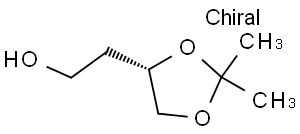
Structural features
The molecule contains a chiral center with a specific stereoconfiguration i.e., the S configuration, which gives the compound unique properties in terms of optical activity and interaction with other chiral molecules, among other things.
The structure of 2,2-dimethyl-1,3-dioxane has certain rigidity and stability, and the oxygen atoms in it can participate in intermolecular interactions such as hydrogen bond formation.
The presence of hydroxyl group (-OH) gives the molecule a certain hydrophilicity and reactivity, and typical reactions of alcohols can occur, such as esterification reaction, oxidation reaction, and replacement reaction with sodium metal.
use
As an intermediate in organic synthesis: it can be used to construct a variety of organic compounds with biological activity or special functions. In drug synthesis, it can be introduced into drug molecules as a chiral building block, and the reactivity of its chiral center and functional group can be used to synthesize chiral drugs with specific pharmacological activities. In the field of fragrance synthesis, compounds with special aromas can be constructed by further chemical reactions.
Used in the field of materials science: it can participate in polymerization reactions as functional monomers, introducing specific functional groups and structural units for polymers, thereby improving the properties of polymers, such as improving the flexibility, water resistance, optical properties of polymers, etc.
Application
(S)-2-(2,2-Dimethyl-1,3-dioxolan-4-yl)ethanol ((S)-4-(2-Hydroxyethyl)-2,2-dimethyl-1,3-dioxolane) is a versatile chiral building block for pharmaceutical and agrochemical synthesis. This enantiomerically pure dioxolane alcohol serves as a key chiral intermediate in the synthesis of antiviral and anticancer agents, where its rigid acetal ring system and primary alcohol facilitate the introduction of stereochemical control and improve the metabolic stability of active pharmaceutical ingredients (APIs). In organic synthesis, it participates in oxidation, reduction, and substitution reactions, while in materials science, it functions as a functional monomer to modify polymers, coatings, and adhesives, enhancing flexibility, water resistance, and optical properties. This compound is also used in the preparation of enantioselective fluorescent probes for bioimaging, the total synthesis of natural products such as rugulactone, and the development of prodrugs and enzyme inhibitors. Its defined (S)-stereocenter and orthogonal functional groups enable precise modification of drug candidates during lead optimization. Xinchem offers custom synthesis, custom chemical synthesis, and contract manufacturing of high-purity (S)-2-(2,2-Dimethyl-1,3-Dioxolan-4-yl)ethanol, with flexible scaling from R&D to commercial tons. Contact us for a competitive quote and reliable global supply.