
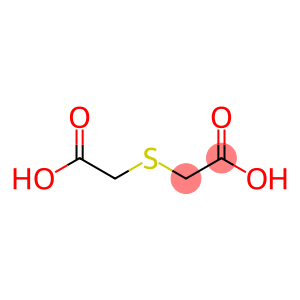
Thiodiglycolic acid(CAS#123-93-3)
| Hazard Symbols | C - Corrosive |
| Risk Codes | R36/37/38 - Irritating to eyes, respiratory system and skin. R34 - Causes burns |
| Safety Description | S26 - In case of contact with eyes, rinse immediately with plenty of water and seek medical advice. S36/37/39 - Wear suitable protective clothing, gloves and eye/face protection. S45 - In case of accident or if you feel unwell, seek medical advice immediately (show the label whenever possible.) |
| UN IDs | UN 3261 8/PG 2 |
| WGK Germany | 3 |
| RTECS | AJ6475000 |
| FLUKA BRAND F CODES | 13 |
| TSCA | Yes |
| HS Code | 29309070 |
| Hazard Note | Corrosive/Stench |
| Hazard Class | 8 |
| Packing Group | III |
| Toxicity | LD50 orally in Rabbit: > 2000 mg/kg |
Introduction
Soluble in water, soluble in alcohol, insoluble in benzene.
Thiodiglycolic acid 2,2 Thiodiacetic acid Dicarboxydimethyl sulfide | CAS 123 93 3
One Line Sourcing Position
High purity Thiodiglycolic acid for chelation chemistry, cosmetic formulations, and pharmaceutical intermediate synthesis.
Quick RFQ Form
Fill below to get instant quote:
Name Email Company Required quantity Delivery destination Submit
Specification
| Parameter | Specification |
|---|---|
| Purity by GC | 98.0 percent minimum, typical batch 98.5 to 99.0 percent |
| Purity by Neutralization Titration | 98.0 percent minimum |
| Appearance | White to almost white powder to crystalline powder |
| Molecular Formula | C4H6O4S |
| Molecular Weight | 150.15 g per mol |
| Melting Point | 128.0 to 132.0 degrees Celsius |
| Solubility in Water | 400 g per L at 25 degrees Celsius |
| pH (10g per L, H2O, 20 deg C) | 2.2 |
| pKa | pK1 3.32, pK2 4.29 at 25 degrees Celsius |
| Residue on Ignition | 0.10 percent maximum |
| Heavy Metals | Less than 10 ppm |
| Stock Status | In Stock in US warehouse and China hub |
Available Quantity and Lead Time
Regular supply: 100 g to 20 metric tons per shipment
Lead time: 3 to 5 days for standard packaging; bulk orders require 7 to 10 days
Document Support
COA SDS HPLC chromatogram NMR spectrum Mass spectrum MS available upon request
Application
Thiodiglycolic acid is a versatile dicarboxylic acid containing a sulfur atom, which confers strong chelating properties and unique chemical reactivity. It serves as an excellent analytical reagent for the detection of heavy metal ions including copper, lead, mercury, and silver, forming characteristic complexes that enable qualitative and quantitative analysis. In the cosmetics industry, it is employed as an antioxidant and reducing agent to stabilize formulations and prevent oxidative degradation of active ingredients. The compound is also a key intermediate in the production of 1,4 oxathiane 2,6 dione through thermal cyclization. In pharmaceutical research, thiodiglycolic acid serves as a building block for the synthesis of various bioactive molecules and has been identified as a major human biotransformation product of S carboxymethyl L cysteine, making it relevant for drug metabolism studies. In cleaning formulations, its chelating properties make it particularly effective for removing metal oxides and contaminants from surfaces in automotive cleaning products. Additionally, it is utilized as a biochemical reagent, an organic synthesis intermediate, and a precursor for sulfur containing polymers and coordination compounds.
Custom Synthesis Support
We offer custom synthesis for thiodiglycolic acid derivatives including esterified, amidated, and metal complexed forms. Custom purity grades (99.0 percent and above) and isotopically labeled analogs are available upon request. Share your technical datasheet for feasibility review.
Packaging and Shipping
Available in 25 g, 100 g, 500 g, 1 kg, 5 kg, or 25 kg fiber drums with polyethylene inner liner. Custom packaging such as double sealed aluminum foil bags under inert atmosphere is supported. Fastest dispatch within 7 days after order confirmation. Thiodiglycolic acid is a corrosive solid, UN 3261, Class 8, Packing Group III. Store in a cool, dry place below 30 degrees Celsius, away from oxidizing agents and strong bases. Keep container tightly closed.
Why XinChem
XinChem provides thiodiglycolic acid with strict control of purity and impurity profile for US customers. Our ISO 9001 certified facility monitors every batch by GC and neutralization titration, ensuring consistent quality for analytical, cosmetic, and pharmaceutical applications. We maintain a buffer stock in US warehouses for emergency deliveries within 48 hours. Each order includes a full documentation package: COA, SDS, and chromatograms accessible through our online portal. Our technical support team assists with handling precautions, stability under storage, and regulatory compliance including TSCA, EINECS (204 663 9), and REACH registration. For contract customers, we offer quarterly price locks and consignment inventory to reduce supply chain risk. Trusted by numerous analytical laboratories, cosmetic ingredient manufacturers, and pharmaceutical research groups in North America. We also provide free sample evaluation for qualified R&D projects and a price match guarantee against any valid competitor quote for equivalent quality. All shipments include clear handling instructions and appropriate hazard communication to ensure safety throughout the supply chain.
FAQ
Q1 How should thiodiglycolic acid be stored safely?
A Store in a cool, dry place below 30 degrees Celsius in tightly closed containers, away from oxidizing agents and strong bases. Shelf life is 24 months under recommended conditions.
Q2 What purity grades do you supply?
A Standard grade is 98.0 percent minimum by GC and neutralization titration. We also supply 99.0 percent grade for pharmaceutical and analytical reference applications upon request.
Q3 Is thiodiglycolic acid soluble in water?
A Yes, it is highly soluble in water at 400 g per L at 25 degrees Celsius. It is also soluble in alcohol and slightly soluble in benzene.
Q4 Do you provide sample quantities for method development?
A Yes, free samples of 25 g are available for qualified US companies. Shipping fee applies for small quantities.
Q5 What safety precautions are required when handling thiodiglycolic acid?
A Thiodiglycolic acid is corrosive and causes severe skin burns and eye damage. It may be corrosive to metals. Use in a fume hood with full PPE including chemical resistant gloves, safety goggles, and protective clothing. Do not breathe dust. In case of contact, rinse immediately with plenty of water and seek medical attention.
Q6 What are the main applications of thiodiglycolic acid?
A Primary applications include: (1) analytical reagent for detection of copper, lead, mercury, and silver; (2) antioxidant and reducing agent in cosmetics; (3) intermediate for 1,4 oxathiane 2,6 dione synthesis; (4) chelating agent in cleaning formulations; and (5) building block for pharmaceutical and biochemical research.