
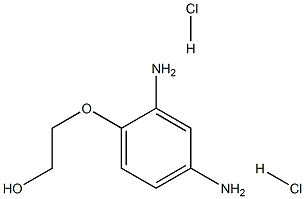
Xanthan gum(CAS#11138-66-2)
| Safety Description | 24/25 - Avoid contact with skin and eyes. |
| WGK Germany | 1 |
| HS Code | 32139000 |
Introduction
Xanthan gum, also known as hydroxypropyl cellulose, is a polymer compound with many special properties and applications. The following is an introduction to the properties, uses, preparation methods and safety information of xanthan gum:Quality:High viscosity: Xanthan gum has a high viscosity and can form a viscous colloidal solution.Gellingability: Xanthan gum has good gelling properties and can form a tough gel state.Heat resistance: Xanthan gum has good stability at high temperatures and can maintain its special properties during thermal processing.Use:Industrial production: Xanthan gum is widely used in oilfields, papermaking, daily chemicals, textiles, and papermaking industries.Preparation method:Xanthan gum is generally prepared through the following steps:Dissolve the cellulose raw material in an alkaline solution.Add crosslinkers such as 3-chloro-2-hydroxypropyltrimonium salt.Neutralization is carried out so that the solution is neutral.Evaporate water or add organic solvents to obtain xanthan gum.Safety Information:Avoid direct contact with xanthan gum and try to wear personal protective equipment such as gloves and protective glasses.Avoid inhaling xanthan gum dust or solutions to avoid respiratory irritation.When using xanthan gum, it should be properly stored and kept away from fire sources and high-temperature environments to prevent it from burning.If you accidentally come into contact with xanthan gum or have an abnormal reaction, rinse immediately with clean water and consult a doctor.
Application
Xanthan gum (CAS 11138-66-2) is a high-molecular-weight polysaccharide produced by bacterial fermentation. As a pseudoplastic hydrocolloid, it provides high viscosity at low shear yet flows easily under stress, making it an excellent rheology control agent. In food applications, it functions as a stabilizer and thickener for salad dressings, sauces, dairy desserts, gluten-free baking, and frozen products, preventing phase separation and ice crystal formation. As a food additive (E415), it improves freeze-thaw stability and mouthfeel. In cosmetics and personal care, it stabilizes oil-in-water emulsions in lotions, creams, shampoos, and toothpaste. Pharmaceutical applications include tablet binding and liquid medication thickening. In oil drilling, it is used in fracturing fluids and mud systems to improve hole cleaning and suspension. It is also employed in paints, ceramic glazes, agrochemicals, and adhesives. Xinchem offers custom synthesis, custom chemical synthesis, and contract manufacturing of high-purity xanthan gum with flexible scaling from R&D to commercial tons. Contact us today for a competitive quote and reliable global supply.