
page_banner

product

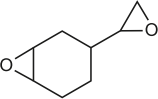
1,2-Epoxy-4-epoxyethylcyclohexane(CAS#106-87-6)

Chemical Property:

106-87-6 - Names and Identifiers

Name 4-Vinylcyclohexene dioxide
Synonyms ERL 4206
ERL(R) 4206
Vinylcyclohexene dioxid
4-Vinylcyclohexene dioxide
Vinylcyclohexene diepoxide
Vinyl-4-cyclohexene dioxide
4-Vinyl-1-cyclohexene dioxide
4-Vinyl-1-cyclohexene diepoxide
3-epoxyethyl-7-oxabicycloheptane
1-EPOXYETHYL-3.4-EPOXYCYCLOHEXANE
1-epoxyethyl-3.4-epoxycyclohexane
3-oxiranyl-7-oxabicyclo(4.1.0)heptan
3-oxiranyl-7-oxabicyclo[4.1.0]heptan
3-oxiranyl-7-oxabicyclo(4.1.0)heptane
3-oxiranyl-7-oxabicyclo(4.1.0)heptene
3-(epoxyethyl)-7-oxabicyclo(4.1.0)heptan
3-epoxyethyl-7-oxabicyclo [4.1.0] heptane
3-(oxiran-2-yl)-7-oxabicyclo[4.1.0]heptane
3-(oxiran-2-yl)-7-oxabicyclo[4.1.0] heptane
CAS 106-87-6

106-87-6 - Physico-chemical Properties

Molecular Formula C8H12O2
Molar Mass 140.18
Density 1.094g/mLat 25°C(lit.)
Melting Point -55°C
Boling Point 230-232°C(lit.)
Flash Point 225°F
Water Solubility 154.7g/L(20 ºC)
Solubility Soluble in water.
Vapor Presure 0.119mmHg at 25°C
Appearance Colorless to yellow liquid
BRN 106071
Storage Condition under inert gas (nitrogen or Argon) at 2-8°C
Stability Stable. Combustible. Incompatible with strong oxidizing agents, alcohols, amines and other compounds containg an active hydrogen. Hydrolyzes slowly in water.
Refractive Index n20/D 1.477(lit.)
MDL MFCD00022354
Use Vinylcyclohexene dioxide (VCD) as an ovarian toxin can be used to study its toxicity. VCD is used to study its toxic mechanism on ovarian follicle and epithelial cell differentiation.


Product Detail

Product Tags

106-87-6 – Introduction

The properties of this compound depend mainly on the presence of its various isomers. It has good solubility and is soluble in a variety of organic solvents.

This mixture has a wide range of uses in the chemical industry. It can be used as a solvent, intermediate, and raw material. For example, it is often used as a reactant or additive in the preparation of epoxy resins, coatings, and adhesives. It can also be used in the synthesis of other chemical compounds and as a catalyst in organic synthesis reactions.

The method for preparing 4-vinyl-1-cyclohexene diepoxide is generally achieved by reacting 4-vinyl-1-cyclohexene with persulfate or peralcohol reagents. This reaction usually needs to be carried out under strictly controlled conditions to ensure the quality of the synthesized product and the isomer ratio.

The 4-vinyl-1-cyclohexene diepoxide isomer mixture is an organic compound and is flammable and irritating. During handling, protective equipment should be worn and good ventilation should be ensured. Avoid contact with strong oxidizing agents, acids, and other substances to prevent possible hazardous reactions. If necessary, read the relevant safety data sheet before use and follow proper operating procedures. If a leak or accident occurs, take appropriate emergency measures, including preventing fire and leakage risks and promptly removing contaminated areas.

  • Previous:
  • Next:

  • Write your message here and send it to us