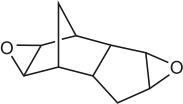
1,2:5,6-Diepoxyhexahydro-4,7-methanoindan(CAS#81-21-0)
81-21-0 – Introduction
Dicyclopentadiene dioxide (also known as dicyclopentadiene diketone, e2klene) is a colorless to pale yellow organic compound. Dicyclopentadiene dioxide has the following properties:
- Density: 1.18 g/mL
- Solubility: soluble in organic solvents such as ethanol and ether, and slightly soluble in water.
Dicyclopentadiene dioxide has certain environmental stability and thermal stability. It is a typical dienyl compound with relatively high reactivity, and it readily undergoes electron transfer reactions and addition reactions.
Dicyclopentadiene dioxide has a wide range of applications in chemical research and industry:
- Polymeric materials: It can be used as a crosslinking agent for polymers or elastomers to improve the strength and heat resistance of materials.
- Chemical synthesis: It is used as an intermediate in the synthesis of important chemicals such as pharmaceuticals and dyes.
- Electronic materials: It can be used as an organic semiconductor material for the preparation of organic light-emitting diodes (OLEDs) and other electronic devices.
- Other applications: It is widely used in coatings, adhesives, plasticizers, fragrances, and the like.
The main methods for preparing dicyclopentadiene dioxide include the following:
- Pyrolysis method: obtained by pyrolyzing dicyclopentadiene at high temperature.
- Oxidation method: obtained by oxidizing dicyclopentadiene with oxygen in the presence of a catalyst.
- Photochemical reaction: synthesized through a photochemical reaction under ultraviolet light irradiation.
Safety information for dicyclopentadiene dioxide: Although there are no clear toxicity data, it is generally considered to have low toxicity. As a chemical, safe operating procedures should still be followed. Avoid contact with skin, eyes, and the respiratory tract, and avoid ingestion. When necessary, use personal protective equipment such as protective goggles, protective gloves, and protective masks. If accidental exposure or ingestion occurs, seek medical attention immediately.