
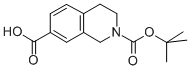
2-(TERT-BUTOXYCARBONYL)-1,2,3,4-TETRAHYDROISOQUINOLINE-7-CARBOXYLIC ACID(CAS#149353-95-7)
Introduction
2-BOC-7-carboxy-1,2,3,4-tetrahydroisoquinoline is a chemical compound. It has the following properties:Appearance: 2-BOC-7-carboxy-1,2,3,4-tetrahydroisoquinoline is a white to yellowish solid powder.Solubility: It is soluble in common organic solvents such as ethanol, dimethylformamide (DMF), and formamide.Stability: It is stable in dry conditions but susceptible to moisture in wet conditions.2-BOC-7-carboxy-1,2,3,4-tetrahydroisoquinoline is mainly used as a raw material and intermediate in organic synthesis. It can be synthesized by a variety of methods, one of the commonly used methods is to combine 7-carboxy-1,2,3,4-tetrahydroisoquinoline with tert-butoxycarbonyl group (BOC). This reaction is usually carried out under alkaline conditions to allow the 7-carboxyl group to react with BOC chloride to form a BOC protecting group.When using 2-BOC-7-carboxy-1,2,3,4-tetrahydroisoquinoline, the following safety information should be noted:Contact: Avoid skin and eye contact with this compound as it may be irritating to the skin and eyes.Inhalation: Avoid inhaling dust or gas from the compound. If you inhale too much, you should go to a well-ventilated area for breathing.Storage: 2-BOC-7-carboxy-1,2,3,4-tetrahydroisoquinoline should be kept in a dry, airtight container away from contact with oxygen and moisture.More detailed operating procedures and safe handling guidelines should be followed when using and manipulating this compound.
Application
2-(Tert-butoxycarbonyl)-1,2,3,4-tetrahydroisoquinoline-7-carboxylic acid (CAS 149353-95-7) is a Boc-protected tetrahydroisoquinoline (THIQ) derivative bearing a free carboxylic acid at the 7-position. This high-purity building block is extensively used in medicinal chemistry and pharmaceutical R&D for the synthesis of central nervous system (CNS) agents, including potential therapeutics for Parkinson’s disease, Alzheimer’s disease, depression, and anxiety. The Boc group enables selective deprotection under acidic conditions, while the carboxylic acid facilitates amide bond formation with amines, allowing rapid construction of diverse drug-like libraries for structure-activity relationship (SAR) studies. This scaffold also serves as a key intermediate for developing protease inhibitors, kinase modulators, and GPCR-targeted drugs. Its rigid THIQ core enhances metabolic stability and blood-brain barrier penetration. Xinchem offers custom synthesis, custom chemical synthesis, and contract manufacturing of this compound with flexible scaling from R&D to commercial tons. Contact us today for a competitive quote and reliable global supply.