
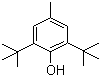
2,6-Di-tert-butyl-4-methylphenol(CAS#128-37-0)
| Risk Codes | R22 - Harmful if swallowed R36/37/38 - Irritating to eyes, respiratory system and skin. R36/38 - Irritating to eyes and skin. R50/53 - Very toxic to aquatic organisms, may cause long-term adverse effects in the aquatic environment. |
| Safety Description | S26 - In case of contact with eyes, rinse immediately with plenty of water and seek medical advice. S36 - Wear suitable protective clothing. S37/39 - Wear suitable gloves and eye/face protection S61 - Avoid release to the environment. Refer to special instructions / safety data sheets. S60 - This material and its container must be disposed of as hazardous waste. |
| UN IDs | 3077 |
| WGK Germany | 1 |
| RTECS | GO7875000 |
| FLUKA BRAND F CODES | 8-10-23 |
| TSCA | Yes |
| HS Code | 29071900 |
| Hazard Class | 9 |
| Packing Group | III |
| Toxicity | LD50 orally in mice: 1040 mg/kg (McOmie) |
Introduction
Half lethal dose (mice, oral) 1040mg/kg, non-toxic.
2,6 Di Tert Butyl 4 Methylphenol Butylated Hydroxytoluene BHT | CAS 128 37 0
One Line Sourcing Position
High purity 2,6 Di Tert Butyl 4 Methylphenol for antioxidant applications in polymers, fuels, foods, and pharmaceuticals.
Quick RFQ Form
Fill below to get instant quote:
Name Email Company Required quantity Delivery destination Submit
Specification
| Parameter | Specification |
|---|---|
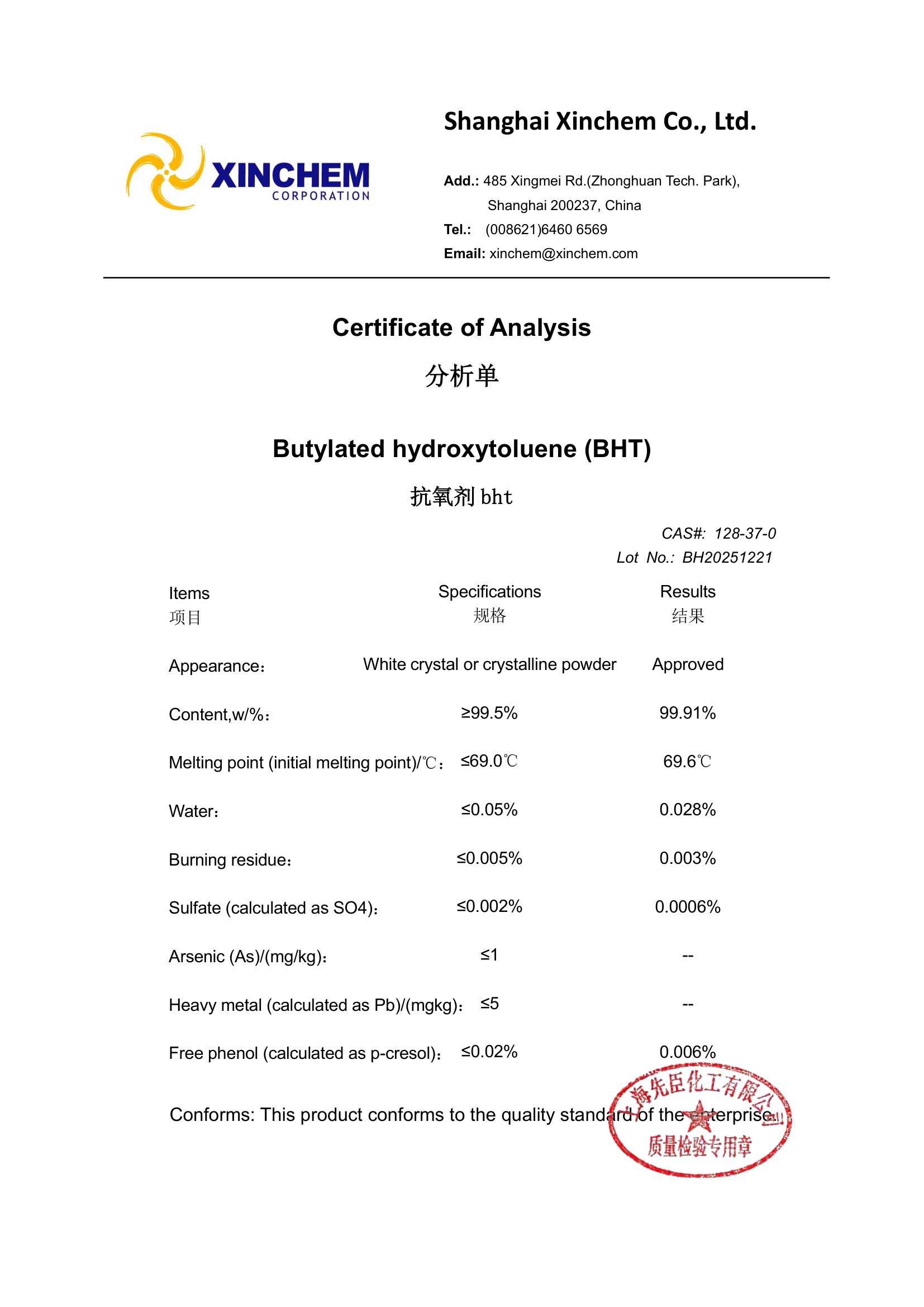
| Purity by GC | 99.0 percent minimum, typical batch 99.0 to 99.7 percent |
| Appearance | White to off white crystalline solid or flakes |
| Molecular Formula | C15H24O |
| Molecular Weight | 220.35 g per mol |
| Melting Point | 69 to 73 degrees Celsius (lit.) |
| Boiling Point | 265 degrees Celsius (lit.) |
| Density | 1.048 g per cm3 at 20 degrees Celsius |
| Refractive Index | 1.4859 |
| Flash Point | 127 degrees Celsius (closed cup) |
| Vapor Pressure | Less than 0.01 mm Hg at 20 degrees Celsius |
| Vapor Density | 7.6 (vs air) |
| Solubility in Water | 0.6 mg per L |
| LogP | 4.30 to 5.32 |
| Residue on Ignition | 0.05 percent maximum |
| Heavy Metals | Less than 10 ppm |
| Stock Status | In Stock in US warehouse and China hub |
Available Quantity and Lead Time
Regular supply: 500 g to 30 metric tons per shipment
Lead time: 3 to 5 days for standard packaging; bulk orders require 7 to 10 days
Document Support
COA SDS HPLC chromatogram NMR spectrum Mass spectrum MS available upon request
Application
2,6 Di Tert Butyl 4 Methylphenol, commonly known as BHT, is one of the most widely used phenolic antioxidants across multiple industries.
In the polymer and plastics industry, it serves as a primary antioxidant for polyolefins, polystyrene, polyurethanes, and elastomers, preventing thermal and oxidative degradation during processing and end use. In rubber manufacturing, it protects natural and synthetic rubber from oxidation and ozone cracking. In the petroleum industry, BHT is used as a fuel additive in gasoline, jet fuels, hydraulic fluids, and turbine and gear oils to prevent peroxide formation and gumming.
In the food industry, BHT is approved as a food additive (E321) to prevent rancidity in fats, oils, and fat containing foods. European and US regulations allow small amounts to be used as a food additive. In pharmaceutical and cosmetic applications, it serves as an antioxidant in gels, creams, liquids, gelatin capsules, tablets, vitamins, and personal care products. It is also used as a stabilizer in cosmetics and toiletries. In research applications, BHT is utilized as a free radical scavenger to inhibit lipid peroxidation and as a ferroptosis inhibitor in biological studies.
Custom Synthesis Support
We offer custom synthesis for 2,6 Di Tert Butyl 4 Methylphenol derivatives including isotopically labeled analogs, high purity grades (99.5 percent and above), and custom formulations. Share your technical datasheet for feasibility review.
Packaging and Shipping
Available in 500 g, 1 kg, 5 kg, 25 kg fiber drums, or 200 kg steel drums with polyethylene inner liner. Custom packaging such as double sealed aluminum foil bags under inert atmosphere is supported. Fastest dispatch within 7 days after order confirmation.
BHT is stable but light sensitive. Store in a cool, dry place at 0 to 6 degrees Celsius, away from direct sunlight, strong oxidizing agents, acid chlorides, acid anhydrides, and bases. Incompatible with brass, copper, copper alloys, and steel. Combustible material. For transportation, UN 3077, Class 9, Packing Group III.
Why XinChem
XinChem provides 2,6 Di Tert Butyl 4 Methylphenol with strict control of purity, color, and heavy metal content for US customers. Our ISO 9001 certified facility monitors every batch by GC and melting point analysis, ensuring consistent quality for antioxidant applications across polymer, fuel, food, and pharmaceutical industries. We maintain a buffer stock in US warehouses for emergency deliveries within 48 hours. Each order includes a full documentation package: COA, SDS, and chromatograms accessible through our online portal. Our technical support team assists with handling recommendations, stability optimization, and regulatory compliance including TSCA, EINECS (204-881-4), FEMA 2184, and FDA food additive regulations. For contract customers, we offer quarterly price locks and consignment inventory to reduce supply chain risk. Trusted by numerous polymer manufacturers, fuel additive formulators, and pharmaceutical companies in North America. We also provide free sample evaluation for qualified R&D projects and a price match guarantee against any valid competitor quote for equivalent quality.
FAQ
Q1 How should 2,6 Di Tert Butyl 4 Methylphenol be stored?
A Store in a cool, dry place at 0 to 6 degrees Celsius, protected from light. Keep container tightly closed when not in use. Avoid contact with copper, brass, and their alloys. Shelf life is 24 months under recommended conditions.
Q2 What purity grades do you supply?
A Standard grade is 99.0 percent minimum by GC. We also supply 99.5 percent and 99.7 percent grades for pharmaceutical and analytical reference applications.
Q3 Is BHT soluble in water?
A BHT is practically insoluble in water (0.6 mg per L). It is freely soluble in toluene, methanol, ethanol, acetone, ethyl acetate, benzene, and most hydrocarbon solvents.
Q4 Do you provide sample quantities for formulation testing?
A Yes, free samples of 100 g are available for qualified US companies. Shipping fee applies for small quantities.
Q5 What are the common applications of BHT?
A BHT is widely used as an antioxidant in polymers, rubber, fuels, lubricants, foods, pharmaceuticals, and cosmetics. It prevents oxidation and extends shelf life of various materials.
Q6 Is BHT approved for use in food products?
A Yes, BHT is approved as a food additive (E321) in the US and Europe. It is also FEMA GRAS (No. 2184) for use as a flavoring adjuvant. Please request our regulatory package for your specific application.