
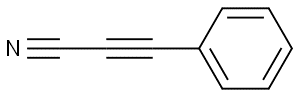
3-phenylprop-2-ynenitrile(CAS# 935-02-4)
| Hazard Symbols | T - Toxic |
| Risk Codes | 25 - Toxic if swallowed |
| Safety Description | 45 - In case of accident or if you feel unwell, seek medical advice immediately (show the label whenever possible.) |
| UN IDs | UN 2811 6.1 / PGIII |
| WGK Germany | 3 |
| RTECS | UE0220000 |
Introduction
3-phenylprop-2-ynenitril is an organic compound with the chemical formula C9H7N. The following is a description of its nature, use, preparation and safety information:
Nature:
1. Appearance: 3-phenylprop-2-ynenitrile is a colorless to light yellow liquid.
2. Melting point: about -5°C.
3. Boiling point: about 220°C.
4. density: about 1.01 g/cm.
5. Solubility: 3-phenylprop-2-ynenitrile is soluble in most organic solvents, such as ethers, alcohols and ketones.
Use:
1. as an intermediate in organic synthesis: 3-phenylprop-2-ynenitrile can be used to synthesize other organic compounds, such as aromatic compounds, nitrile compounds, etc.
2. Material science: It can be used for polymer synthesis and functional modification to change the properties of polymers.
Method:
3-phenylprop-2-ynenitril is prepared by reacting a phenyl nitro compound with sodium cyanide. Specific steps include:
1. The phenyl nitro compound is reacted with sodium cyanide under alkaline conditions.
2. The 3-phenylprop-2-ynenitril produced during the reaction is obtained by extraction and distillation purification.
Safety Information:
1. 3-phenylprop-2-ynenitril should be operated in a well-ventilated place, avoiding inhalation of steam or contact with skin and eyes.
2. It may be irritating to the skin and eyes, so rinse with water immediately after contact.
3. Wear appropriate personal protective equipment such as goggles, gloves and lab coats when operating.
4. 3-phenylprop-2-ynenitril should be stored in a sealed container, away from open flames and high temperatures.
5. When disposing of waste, local disposal regulations should be followed.
Application
3-Phenylpropiolonitrile (3-Phenyl-2-propynenitrile, CAS 935-02-4) is a high-purity, electron-deficient terminal alkyne featuring a phenyl ring directly conjugated to a nitrile group via a carbon-carbon triple bond. This unique C9H5N framework (MW 127.14 g/mol, mp 37–42 °C) creates a strongly polarized, electrophilic alkyne moiety that underpins its differentiated reactivity in organic synthesis. In medicinal chemistry and pharmaceutical research, this versatile building block serves as a key intermediate for synthesizing carboxypeptidase B enzyme inhibitors, potential anticancer agents, and various bioactive compounds. It also acts as a precursor for 3-aminoisoxazoles and other heterocyclic scaffolds via cyclocondensation reactions. In biocatalysis, the ene-reductase CtOYE demonstrates exclusive selectivity for the partial reduction of 3-phenylpropiolonitrile, yielding only the (Z)-isomer of cinnamonitrile with zero over-reduction. In agrochemical research, this compound serves as a starting material for the synthesis of pesticides and herbicides. Its applications extend to material science, where it is used for polymer synthesis and functional modification to alter polymer properties. Additionally, 3-phenylpropiolonitrile derivatives have been investigated as corrosion inhibitors. The compound also finds use in the production of dyes and other chemical intermediates. Xinchem offers custom synthesis, custom chemical synthesis, and contract manufacturing of high-purity 3-phenylpropiolonitrile with flexible scaling from R&D to commercial tons. Contact us for a competitive quote and reliable global supply.