
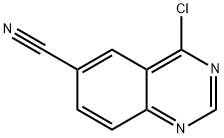
4-Chloroquinazoline-6-carbonitrile(CAS#150449-97-1)
Introduction
4-Chloroquinazoline-6-carbonitrile is an organic compound.Here are some of the properties of 4-Chloroquinazoline-6-carbonitrile:Appearance: colorless or pale yellow solidSolubility: soluble in most organic solvents, such as dimethyl sulfoxide and dimethylformamide, slightly soluble in water.4-Chloroquinazoline-6-carbonitrile is mainly used as an intermediate in organic synthesis.The preparation of 4-Chloroquinazoline-6-carbonitrile is generally synthesized by a series of chemical reactions. A common method is to first use 2-chloroquinazoline as raw material and obtain 4-chloroquinazoline-6-carbonitrile through cyanidation reaction.Safety Information: 4-Chloroquinazoline-6-carbonitrile is an intermediate in organic synthesis that requires proper handling in the laboratory and appropriate personal protective measures, such as gloves, goggles, and laboratory clothing. It should be stored in a dry, cool place, away from fire and flammable materials. For the use and handling of any chemical, the relevant safe handling and handling practices should be followed. When using this compound, it is necessary to refer to the relevant safety data sheets and chemical management regulations.
Application
4-Chloroquinazoline-6-carbonitrile (CAS 150449-97-1) is a functionalized quinazoline derivative featuring a reactive chlorine at the 4-position and a nitrile group at the 6-position. This versatile heterocyclic building block is widely used in medicinal chemistry and drug discovery for the synthesis of potent tyrosine kinase inhibitors, particularly targeting EGFR, HER2, and VEGFR in non-small cell lung cancer, breast cancer, and other malignancies. The chlorine undergoes selective nucleophilic aromatic substitution with amines to produce anilinoquinazolines such as gefitinib and erlotinib analogs, while the nitrile group serves as a hydrogen bond acceptor and metabolic stability enhancer. This scaffold also enables cross-coupling reactions and further functionalization for structure-activity relationship (SAR) studies. It is utilized in developing antiviral, anti-inflammatory, and antimicrobial agents. High purity ensures reproducible results in high-throughput screening and scalable GMP manufacturing. Xinchem offers custom synthesis, custom chemical synthesis, and contract manufacturing of this key API intermediate with flexible scaling from R&D to commercial tons. Contact us today for a competitive quote and reliable global supply.