
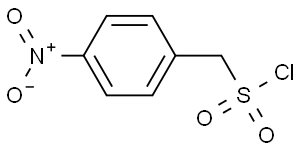
(4-nitrophenyl)methanesulfonyl chloride(CAS#4025-75-6)
| Risk Codes | R14 - Reacts violently with water R29 - Contact with water liberates toxic gas R34 - Causes burns R22 - Harmful if swallowed |
| Safety Description | S22 - Do not breathe dust. S26 - In case of contact with eyes, rinse immediately with plenty of water and seek medical advice. S30 - Never add water to this product. S36/37/39 - Wear suitable protective clothing, gloves and eye/face protection. S45 - In case of accident or if you feel unwell, seek medical advice immediately (show the label whenever possible.) |
| UN IDs | UN3261 |
| Hazard Class | 8 |
| Packing Group | II |
Introduction
(4-nitrophenyl)methanesulfonyl chloride is an organic compound with a chemical formula of C7H6ClNO5S. It is a light yellow crystal with a spicy smell. The following is a detailed description of the nature, use, preparation and safety information of (4-nitrophenyl)methanesulfonyl chloride:
Nature:
-Appearance: light yellow crystal
-Odor: Spicy smell
-Melting point: about 130-132°C
-Boiling Point: 273-275°C
-Density: 1.54g/cm³ (20°C)
-Solubility: Soluble in organic solvents such as dimethyl sulfoxide and ethanol, insoluble in water
Use:
- (4-nitrophenyl)methanesulfonyl chloride is a commonly used organic synthesis reagent, which can be used to prepare other compounds, such as acylating agents and chlorinated reagents.
-In the field of medicinal chemistry and organic synthesis, it is usually used as a reagent to quench amine groups, which can convert amine groups into sulfonyl chloride functional groups to initiate reactions.
-It can also be used to synthesize biologically active compounds, such as drugs and dyes.
Preparation Method:
General method for preparing (4-nitrophenyl)methanesulfonyl chloride:
1. At low temperature, in the presence of sodium carbonate or potassium carbonate, p-nitrotoluene is reacted with sulfonyl chloride.
2. After completion of the reaction, crystals of the product were obtained by cooling and filtration.
Safety Information:
- (4-nitrophenyl)methanesulfonyl chloride irritant to skin, eyes and respiratory tract, rinse with plenty of water immediately after contact and seek medical help.
-it is a pungent odor substances, the operation should pay attention to avoid inhalation of its vapor.
-It is necessary to operate in a well-ventilated area and wear suitable protective equipment, such as gloves, glasses and protective masks.
-Keep away from fire and oxidant to avoid contact with combustibles.
-Storage should be sealed and placed in a cool, dry place, away from fire and acid.
Application
(4-Nitrophenyl)methanesulfonyl chloride (4-nitro-α-toluenesulfonyl chloride) is a high-purity organosulfur compound. It is a certified Sumatriptan Impurity 7 reference standard for ANDA submissions, crucial for analytical method development, method validation (AMV), and quality control. As a versatile electrophilic reagent, it enables native chemical ligation for the synthesis of HIV-1 Tat protein via selective sulfonylation of asymmetric calix[4]arenes. Its unique methylene spacer provides distinctive electrophilicity and steric profile, allowing for regioselective sulfonylation reactions essential in orthogonal protection strategies. The reagent readily undergoes nucleophilic substitution with amines, alcohols, and thiols to form sulfonamide, sulfonate, and sulfonothioate derivatives for constructing pharmaceutical intermediates. The para-nitrophenyl moiety enables easy reduction to the corresponding amine for further functionalization. Its superior stability, with a melting point of 90‑94°C, ensures physical robustness during long-term storage and automated pharmaceutical manufacturing processes. As a specialty linker building block for supramolecular chemistry, (4-nitrophenyl)methanesulfonyl chloride is an irreplaceable reagent in the creation of macrocycles and custom molecular structures. Xinchem provides flexible custom synthesis and contract manufacturing, scaled from R&D to commercial tons, with full regulatory documentation. Contact us for a competitive quote.