
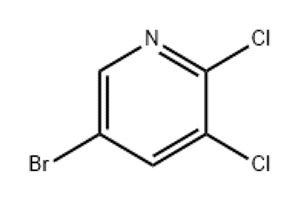
5-Bromo-2-3-dichloropyridine(CAS#97966-00-2)
Risk and Safety
| Risk Codes | R36/37/38 - Irritating to eyes, respiratory system and skin. R41 - Risk of serious damage to eyes R37/38 - Irritating to respiratory system and skin. R25 - Toxic if swallowed |
| Safety Description | S26 - In case of contact with eyes, rinse immediately with plenty of water and seek medical advice. S45 - In case of accident or if you feel unwell, seek medical advice immediately (show the label whenever possible.) S39 - Wear eye / face protection. |
Introduction
-Appearance: Colorless to light yellow crystal or crystalline powder
-Melting point: 62-65°C
-Boiling point: 248°C
-Density: 1.88g/cm³
-insoluble in water, soluble in organic solvents (such as chloroform, methanol, ether, etc.)Use:
- 5-bromo-2,3-dichloropyridine is an important intermediate in organic synthesis.
-It can be used to prepare labeled compounds containing gaseous radioactive carbon isotopes.
Preparation Method:
The preparation method of -5-bromo-2,3-dichloropyridine is usually obtained by bromination substitution reaction of 2,3-dichloro-5-nitropyridine. The specific method is to first react 2,3-dichloro-5-nitropyridine with phosphorus trichloride, and then carry out bromination substitution reaction with bromine.
Safety Information:
- 5-bromo-2,3-dichloropyridine is an organic compound and needs to follow safe operating procedures when handling and using.
-It may be irritating to the eyes, skin and respiratory system, so wear goggles, gloves and a mask.
-Please keep it properly, away from fire, heat and oxidant, and avoid contact with strong acid and alkali.
-In case of inhalation or accidental contact, clean the affected area immediately and seek medical help.
Application
5-Bromo-2,3-dichloropyridine is a trihalogenated pyridine used as a key pharmaceutical intermediate and agrochemical building block. Its orthogonal halogens enable chemoselective cross-couplings (Suzuki-Miyaura, Buchwald‑Hartwig, Sonogashira) for rapid SAR exploration. This scaffold is essential for kinase inhibitors, anticancer and antifungal agents, and compounds targeting neurological disorders such as Alzheimer’s and Parkinson’s. As an agrochemical intermediate, it is used to produce herbicides and insecticides. It also supports material science (polymers, coatings) and analytical chemistry. Xinchem offers custom synthesis and contract manufacturing of this high-purity compound with flexible scaling from R&D to commercial tons. Contact us for a competitive quote.