
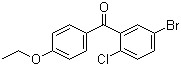
(5-bromo-2-chlorophenyl)(4-ethoxyphenyl)methanone(CAS#461432-22-4)
(5-bromo-2-chlorophenyl)(4-ethoxyphenyl)methanone(CAS#461432-22-4) introduction
Solvent blue 59, also known as methylene blue, is an organic dye. The following is some of the properties, uses, manufacturing methods and safety information about solvent blue 59:
Quality:
- Solvent Blue 59 is a blue crystalline solid.
- It is insoluble in water but soluble in alcoholic solvents and organic solvents.
- Its chemical structure contains methylene blue groups.
Use:
- Solvent blue 59 is mainly used as a direct dye and can be applied to the dyeing of cotton, linen and chemical fibers.
- It is also used as a chromogenic agent in biological experiments, especially in protein gel electrophoresis analysis.
Method:
- Solvent blue 59 can be prepared by various synthetic routes, including diazosalt coupling reactions of methylene blue and other dyes.
Safety Information:
- Solvent blue 59 is an organic dye and has certain toxicity.
- During use, avoid contact with skin and eyes, and avoid inhaling their dust.
- Care should be taken to prevent the danger of fire and explosion when handling and storing.
- In case of accidental ingestion or exposure, seek medical attention immediately and present the container or label to a doctor.
Application
(5-Bromo-2-chlorophenyl)(4-ethoxyphenyl)methanone is a functionalized benzophenone derivative featuring orthogonal halogens (bromo and chloro) and an ethoxy substituent. This versatile building block is widely used in medicinal chemistry for the synthesis of selective kinase inhibitors targeting cancer, inflammation, and autoimmune diseases. The reactive carbonyl group enables further derivatization via nucleophilic addition or reduction, while the halogen atoms allow regioselective cross-coupling reactions (Suzuki-Miyaura, Buchwald-Hartwig, Sonogashira) to rapidly expand structure-activity relationships. Its rigid, lipophilic core enhances metabolic stability and target binding affinity. In agrochemical research, this scaffold serves as a precursor for novel herbicides and fungicides with improved environmental profiles. Additionally, it finds applications in materials science for the preparation of organic semiconductors and photoinitiators. High purity ensures reproducible results in high-throughput screening, SAR studies, and GMP manufacturing. Xinchem offers custom synthesis, custom chemical synthesis, and contract manufacturing of this key intermediate with flexible scaling from R&D to commercial tons. Contact us today for a competitive quote and reliable global supply.