
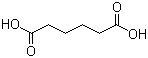
Adipic Acid(CAS#124-04-9)–Nylon Monomer & Dicarboxylic Acid
1. Properties:
- Appearance and Physical Form: Adipic acid is a white monoclinic prismatic crystal or crystalline powder with a characteristic odor resembling burnt bone (charred‑bone smell). The product exhibits excellent uniformity and consistent end‑use performance. It sublimes upon heating.
- Solubility: Adipic acid is sparingly soluble in water at room temperature (1.44 g/100 mL at 15°C), with solubility rising markedly with temperature (16 g/100 mL at 100°C). It is readily soluble in polar organic solvents including methanol, ethanol, acetone, and is slightly soluble in cyclohexane, while being almost insoluble in benzene and petroleum ether. The compound forms acidic aqueous solutions with a pH of approximately 2.7 at 24.9 g/L.
- Chemical Properties: As a dicarboxylic acid with the structural formula HOOC(CH₂)₄COOH, adipic acid exhibits typical carboxylic acid chemistry. It can undergo salt formation, esterification, amidation, and polymerization reactions with diamines or diols, making it a highly versatile compound in chemical synthesis. The molecule contains two carboxyl functional groups that donate hydrogen ions in the presence of bases, enabling it to function as a pH regulator, buffer, acidulant, and cross‑linking agent across multiple applications.
2. Applications:
Nylon 66 & Engineering Plastics (Primary):
- Nylon 66 Production: Adipic acid serves as the primary monomer for the production of nylon 66 (polyamide 66) through polycondensation with hexamethylenediamine. Nylon 66 is a high‑performance engineering plastic widely used in automotive parts (engine covers, air intake manifolds, radiator tanks), electrical connectors, textile fibers (apparel, carpets, industrial fabrics), and electronic components.
- Polyester Resins: Used as a key intermediate in the synthesis of polyester polyols for polyurethanes, as well as in coatings, adhesives, sealants, and elastomers.
- Engineering Plastics & Lightweight Materials: With increasing demand for lightweight engineering plastics in automotive and industrial applications, adipic acid plays a critical role in improving fuel efficiency and reducing emissions through weight reduction.
Polyurethane & Plasticizers:
- Polyurethane Foams & Elastomers: Adipic acid is a key raw material for polyester polyols used in polyurethane foams (flexible and rigid), elastic fibers, synthetic leather (PU), thermoplastic polyurethane elastomers (TPU), and polyurethane coatings.
- Plasticizers (DOA): Adipic acid is used to produce dioctyl adipate (DOA), a high‑performance cold‑resistant plasticizer for PVC, rubber, and other polymer materials. DOA enhances low‑temperature flexibility, durability, and processing characteristics.
- Synthetic Lubricants & Esters: Dicarboxylic acid esters derived from adipic acid are used in high‑grade lubricants, synthetic oils, and hydraulic fluids with excellent thermal stability and low‑temperature flow properties.
Food & Beverage Industry:
- Food Additive (E355): Adipic acid is approved as a food additive (E355) and serves as an acidulant, buffering agent, leavening agent, neutralizing agent, and flavor enhancer. It imparts a tart flavor to beverages, gelatin desserts, baking powders, and confectionery products. Its acidifying effect sometimes surpasses that of citric and tartaric acids. Adipic acid is also listed by FEMA (Flavor and Extract Manufacturers Association) as a flavoring agent and adjuvant with FEMA number 2011.
Cosmetics & Personal Care:
- pH Adjuster & Buffering Agent: Adipic acid is widely used in cosmetic formulations as a pH regulator and stabilizer, helping to stabilize formulation pH and improve texture.
- Excipient & Skin Care: In skin care products, adipic acid functions as a mild exfoliant (beta‑hydroxy acid equivalent) and as a pH adjuster. The Cosmetic Ingredient Review (CIR) has determined adipic acid to be safe for use in cosmetics, subject to concentration or use limitations, with low concerns for cancer, allergies, and reproductive/developmental toxicity.
Pharmaceutical Industry:
- Pharmaceutical Excipient: Adipic acid is used as an excipient in drug formulations, where it aids in the stability and controlled release of active ingredients, improving medication efficacy.
- Controlled‑Release Formulations: Serves as a component in controlled‑release drug delivery systems and as a pH‑dependent solubility modifier.
Textile Industry:
- Textile Treatment Agent: Adipic acid is used in textile processing as a treatment agent for synthetic fibers, improving fabric hand feel and processing characteristics.
- Nylon Fibers: As the monomer for nylon 66, adipic acid is fundamental to the production of nylon fibers used in apparel, sportswear, carpets, upholstery, and industrial fabrics.
Paints, Coatings & Adhesives:
- Coatings & Resins: Adipic acid is employed in the production of polyester resins for powder coatings, automotive primers, industrial coatings, and can coatings. It enhances hardness, flexibility, and weather resistance.
- Adhesives & Sealants: Used as a building block for polyurethane adhesives, epoxy curing agents (when converted to adipic dihydrazide), and hot‑melt adhesives, providing strong bonding performance and durability.
- Corrosion Inhibitor: Functions as a corrosion inhibitor in metal treatment and protective coating formulations.
Industrial & Miscellaneous Applications:
- Corrosion Inhibitor in Metal Treatment: Adipic acid is used in metalworking fluids as a corrosion inhibitor to protect ferrous metals from rust and oxidation during processing and storage.
- Textile & Leather Auxiliary: Used in synthetic leather (PU) production as a raw material for polyurethane resins and as an auxiliary agent in leather finishing.
- Agrochemicals: Serves as an intermediate in the synthesis of certain pesticides, biocides, and plant growth regulators.
- Dye & Pigment Intermediate: Used in the production of synthetic dyes and pigments for textile, printing ink, and coating applications.
- Paper & Pulp Industry: Applied as a wet strength resin additive and as a component in paper coating formulations to improve paper properties.
- Concrete & Construction Additive: Used as an air‑entraining agent in concrete and as an additive in gypsum board and plaster formulations to improve workability and freeze‑thaw resistance.
3. Preparation Method:
- Laboratory Method: Adipic acid can be prepared in the laboratory by the oxidation of cyclohexanol or cyclohexanone (KA oil) with concentrated nitric acid under controlled temperature conditions (60–80°C). The reaction produces adipic acid along with nitrous oxide (N₂O) and water. The crude product is purified by recrystallization from hot water or dilute nitric acid.
- Industrial Process: Industrial production of adipic acid primarily follows the nitric acid oxidation route. Key steps include: (1) Cyclohexane Oxidation: Cyclohexane is oxidized with air to produce a mixture of cyclohexanol and cyclohexanone (KA oil). (2) Nitric Acid Oxidation: The KA oil mixture is oxidized with 50–60% nitric acid at 60–80°C under atmospheric or elevated pressure, yielding crude adipic acid, along with byproducts including glutaric acid and succinic acid. (3) Crystallization & Purification: The crude product is cooled to crystallize adipic acid, which is then separated, washed with water, and recrystallized from hot water or dilute acid to achieve high purity (≥99.7%). (4) Drying & Packaging: The purified crystals are dried and packaged in 25 kg bags, FIBCs, or bulk containers. More recently, bio‑based production routes using renewable feedstocks (e.g., glucose fermentation) have been developed to reduce the carbon footprint and eliminate nitrous oxide emissions associated with the traditional nitric acid process.
4. Safety Information:
- Hazard Classification: According to GHS/CLP Regulation, adipic acid is classified as follows:
- H319 (Causes serious eye irritation)
- H315 (Causes skin irritation)
- H335 (May cause respiratory irritation)
- H412 (Harmful to aquatic life with long‑lasting effects)
- Hazard Symbols: Xi (Irritant)
- Signal Word: Warning/Danger (depending on grade; some formulations carry H318 with signal word Danger)
- Health Hazards: Adipic acid causes irritation to the eyes, skin, mucous membranes, and upper respiratory tract upon direct contact or inhalation of dust. No occupational injury reports have been documented in industrial use, but precautionary measures should still be followed. The substance is harmful to aquatic life with long‑lasting effects (H412) and should be handled with care to prevent environmental release.
- First Aid Measures:
- Eye Contact: Rinse immediately with plenty of water for at least 15 minutes while keeping eyelids open. Remove contact lenses if present and easy to do. Seek medical attention if irritation persists.
- Skin Contact: Wash immediately with plenty of soap and water. Remove contaminated clothing. If skin irritation develops, seek medical advice.
- Inhalation: Move victim to fresh air. Keep at rest in a position comfortable for breathing. If symptoms (coughing, throat irritation) persist, seek medical advice.
- Ingestion: Rinse mouth. Do NOT induce vomiting. Seek immediate medical attention. Drink plenty of water if conscious.
- Explosion & Fire Hazards: Finely dispersed adipic acid particles can form explosive mixtures in air. Prevent dust deposition; use closed systems and dust‑explosion‑proof electrical equipment. In case of fire, keep containers cool by spraying with water. Use water spray, foam, dry powder, or CO₂ as extinguishing media.
- Storage & Stability: Store in tightly closed, corrosion‑resistant containers in a cool, dry, well‑ventilated area away from direct sunlight, heat sources, strong bases, and strong oxidizing agents. Protect from moisture and physical damage. Keep away from ignition sources. Under recommended storage conditions, adipic acid has a shelf life of 12–24 months in original sealed containers.
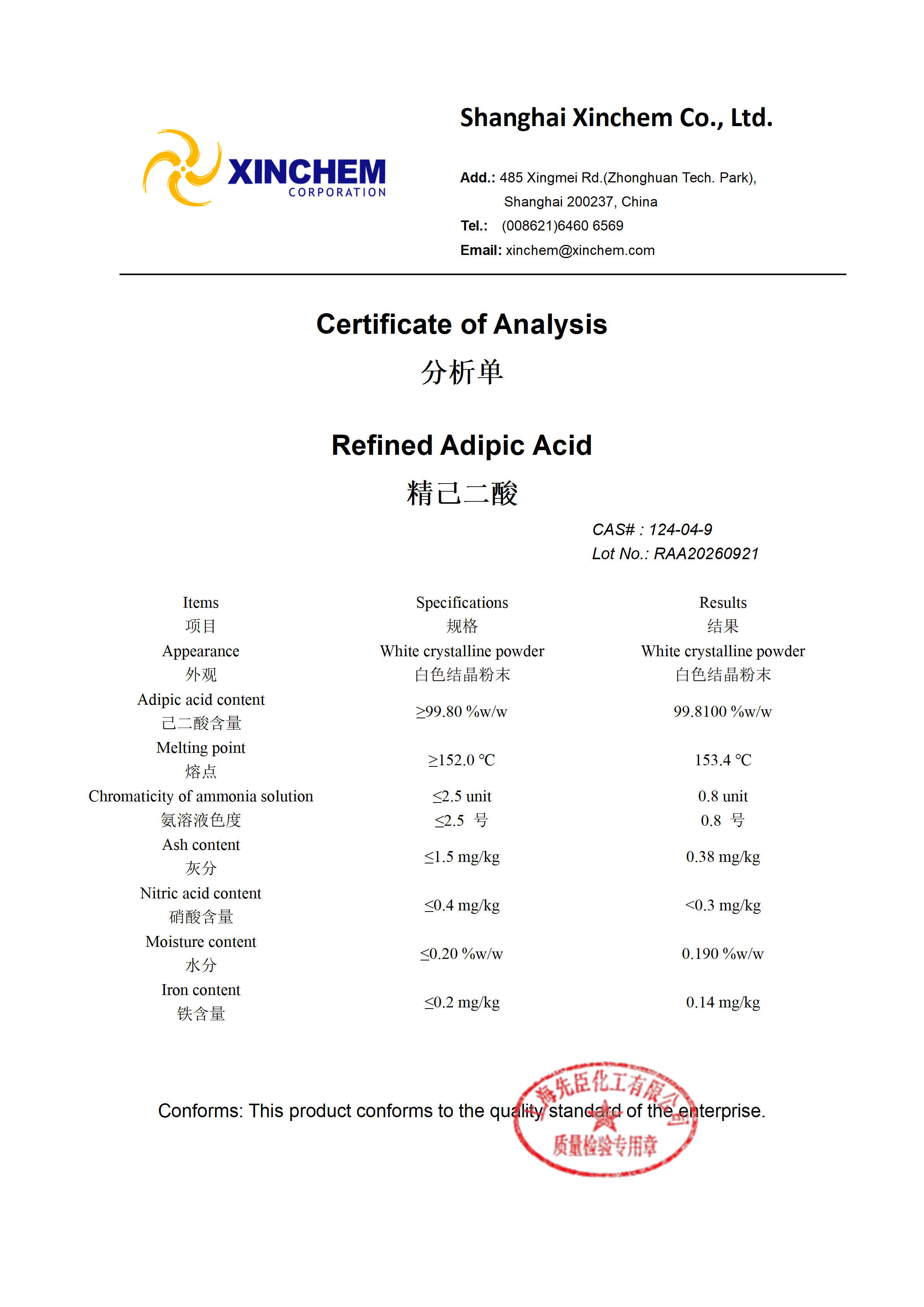
- Regulatory Compliance: Adipic acid (CAS#124-04-9, EC#204-673-3) is listed on EINECS, TSCA, DSL, AICS, NZIoC, ENCS, KECI, PICCS, and other regional chemical inventories. It is approved for use as a food additive (E355) in many jurisdictions and as an excipient in pharmaceutical and cosmetic products. Always consult the Safety Data Sheet (SDS) and local regulations for complete safety, environmental, and regulatory information specific to each product grade and application.
Write your message here and send it to us