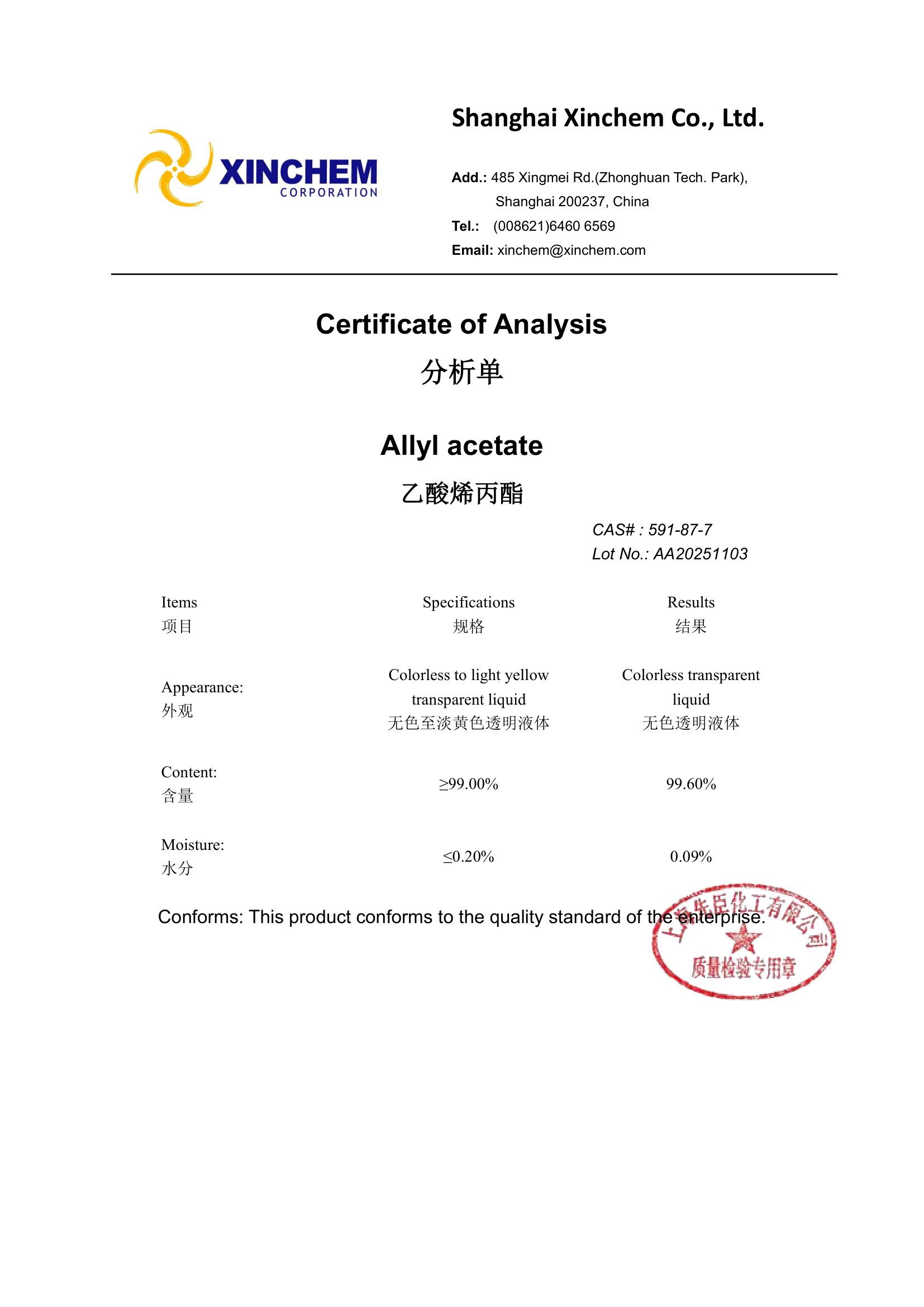


Allyl acetate(CAS#591-87-7)
| Risk Codes | R11 - Highly Flammable R21 - Harmful in contact with skin R23/25 - Toxic by inhalation and if swallowed. R36 - Irritating to the eyes R25 - Toxic if swallowed |
| Safety Description | S16 - Keep away from sources of ignition. S26 - In case of contact with eyes, rinse immediately with plenty of water and seek medical advice. S36 - Wear suitable protective clothing. S45 - In case of accident or if you feel unwell, seek medical advice immediately (show the label whenever possible.) S27 - Take off immediately all contaminated clothing. |
| UN IDs | UN 2333 3/PG 2 |
| WGK Germany | 3 |
| RTECS | AF1750000 |
| TSCA | Yes |
| HS Code | 29153990 |
| Hazard Class | 3 |
| Packing Group | II |
| Toxicity | LD50: 0.13 g/kg orally in rats; 1.1 ml/kg dermally in rabbits (Smyth); LD50 in rats, mice (mg/kg): 142, 170 orally (Jenner) |
Introduction
Allyl acetate. Allyl acetate is a flammable liquid that forms an explosive mixture with air.One of the primary uses of allyl acetate is as an industrial solvent, which can be used to dissolve resins, paints, inks, and more. It is also widely used in the manufacture of synthetic fragrances and flavors, as well as as as an ingredient in rubber plasticizers and rubber binders.The preparation method of allyl acetate can generally be obtained by the esterification reaction between ethanol and acrylate. The specific steps are to mix ethanol and acrylate in a certain proportion, add an acid catalyst, heat reaction to obtain allyl acetate, and purify it by distillation.Its flammability should be kept away from fire sources and high temperatures. When storing and handling allyl acetate, proper ventilation measures should be taken to avoid inhalation of its vapors.
Application
Allyl acetate (CAS 591-87-7) is a reactive unsaturated ester widely used as a monomer in the production of allyl resins, polymers, and copolymers. It serves as a crosslinking agent and reactive diluent in the manufacture of coatings, adhesives, and thermoset plastics, enhancing hardness, chemical resistance, and thermal stability. In organic synthesis, it is a key intermediate for the production of allyl alcohol, glycidol, and other allyl derivatives via hydrolysis or epoxidation. It is also employed in the synthesis of pharmaceuticals, agrochemicals, and fragrance compounds. As a specialty chemical, allyl acetate functions as a modifier for unsaturated polyester resins and as a grafting agent for polymer functionalization. Its high reactivity and purity ensure consistent performance in sensitive polymerization and synthetic applications. Xinchem offers custom synthesis, custom chemical synthesis, and contract manufacturing of high-purity allyl acetate with flexible scaling from R&D to commercial tons. Contact us today for a competitive quote and reliable global supply.