
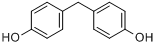
BsphenolF(CAS#620-92-8)
Bisphenol F, chemically designated as 4,4′-methylenediphenol or bis(4-hydroxyphenyl)methane, is a diphenol consisting of two phenol rings linked by a methylene bridge. It is supplied as a white to pale yellow crystalline solid with a melting point of approximately 158–164 °C. The compound is sparingly soluble in water but dissolves in ethanol, acetone, ether, and alkaline solutions, reflecting the acidic character of its phenolic hydroxyl groups. Its methylene bridge, in contrast to the isopropylidene group of bisphenol A, reduces steric hindrance and intermolecular packing, a structural feature that directly translates into the lower viscosity of downstream Bisphenol F–based epoxy resins.
Bisphenol F is typically handled and sold as a mixture of isomers, with the 4,4′-isomer being the most commercially significant; 2,4′- and 2,2′-isomers may be present in varying proportions depending on the manufacturing route and purification. The compound is chemically stable under dry, ambient conditions but may discolor upon prolonged exposure to ultraviolet light.
Applications
The primary application of Bisphenol F is as a low-viscosity monomer for high-performance epoxy resins. Compared with bisphenol A epoxy resins, Bisphenol F–based epoxy systems exhibit significantly lower viscosity and superior processability, enabling formulation of solvent-free and ultra-high-solids coatings, flooring, castings, impregnants, laminates, and lining materials. These resins are valued in electronics encapsulation, adhesives, and protective coatings where low viscosity must be achieved without sacrificing crosslink density or thermal and chemical resistance.
Bisphenol F is also a key monomer for polycarbonate resins. Polycarbonates derived from Bisphenol F exhibit good solubility in low-boiling solvents such as dichloromethane, a lower softening point, and excellent processability, making them suitable for molding materials and films that require toughness and dimensional stability. In polyester resins, Bisphenol F is first alkoxylated to yield a diphenol-type diol, which is then reacted with dibasic acids to produce resins with low viscosity, balanced mechanical and chemical resistance, and particular suitability for corrosion-resistant applications.
Additional uses include the production of oil-soluble phenolic resins, flame retardants, antioxidants, surfactants, and rubber anti-aging agents. Bisphenol F has also been increasingly used as a replacement for bisphenol A in certain consumer and industrial products in response to regulatory and market pressures surrounding BPA. However, this substitution has not eliminated hazard concerns, as discussed below.
Preparation Method
Bisphenol F is produced industrially by the acid-catalyzed condensation of phenol with formaldehyde. A large excess of phenol is typically used to favor formation of the diphenol product and to suppress higher oligomers (novolac resins). The reaction proceeds via protonation of the formaldehyde-derived methylol intermediate, followed by electrophilic attack on the ortho and para positions of phenol, yielding a mixture of 4,4′-, 2,4′-, and 2,2′-isomers.
The choice of acid catalyst significantly influences isomer distribution, product color, and process economics. Strong mineral acids such as sulfuric acid and hydrochloric acid are effective but suffer from equipment corrosion and side reactions that generate chloromethyl ethers and chloromethylphenols, complicating purification. Phosphoric acid is a preferred industrial catalyst in some processes because phenol has low solubility in phosphoric acid, which facilitates phase separation, product isolation, and catalyst recycling; with phosphoric acid, formaldehyde conversion of approximately 90% and a 4,4′:2,4′:2,2′ isomer ratio of about 55:37:8 have been reported. Oxalic acid has also been described in patent literature as a suitable catalyst for the condensation, with the reaction mixture subsequently heated to remove water and drive conversion. Crude Bisphenol F is isolated by neutralization, filtration, distillation, and recrystallization or other purification steps to reach commercial purity, typically ≥98%.
Safety Information
Bisphenol F carries significant regulatory and health hazard classifications. Under the EU REACH framework, 4,4′-methylenediphenol (Bisphenol F) has been proposed as a Substance of Very High Concern (SVHC) owing to its classification as toxic for reproduction, Category 1A or 1B (H360). This reproductive toxicity classification is the central regulatory driver for recent risk management discussions, particularly given the compound's increasing use as a BPA substitute.
The harmonized and supplier-reported GHS hazards commonly include H315 (Causes skin irritation) , H317 (May cause an allergic skin reaction) , H319 (Causes serious eye irritation) , and H335 (May cause respiratory irritation). Some classifications also include H361 (Suspected of damaging fertility or the unborn child) and H411 (Toxic to aquatic life with long lasting effects) , reflecting reproductive and environmental concerns. Bisphenol F is therefore not a benign drop-in replacement for BPA from a hazard perspective, and its use should be evaluated with the same scrutiny applied to BPA in applications where human exposure is possible.
For safe handling, avoid generating or inhaling dust and prevent contact with skin and eyes. Use local exhaust ventilation where dust may be produced, and wear protective gloves, protective clothing, and eye/face protection. In case of skin contact, wash with plenty of soap and water; in case of eye contact, rinse cautiously with water for several minutes. Store in a sealed, dry, cool place protected from light and away from strong oxidizing agents. Spills should be collected in a manner that minimizes dust generation and disposed of in accordance with local environmental regulations, with particular attention to preventing release to watercourses given the aquatic toxicity classification.