
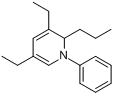
3,5-Diethyl-1,2-dihydro-1-phenyl-2-propylpyridine (CAS#34562-31-7)
3,5-Diethyl-1,2-dihydro-1-phenyl-2-propylpyridine, commonly abbreviated as DHP, is a 1,2-dihydropyridine derivative featuring a phenyl substituent at the nitrogen atom, ethyl groups at the 3- and 5-positions, and a propyl chain at the 2-position. It is supplied as a light yellow to reddish, mobile liquid with a high refractive index (approximately 1.57) and a density near 0.93–0.97 g/cm³. The compound is practically insoluble in water (53.23 μg/L at 25 °C) but is expected to be soluble in most organic solvents given its high lipophilicity (LogP 5.37–6.58). It is a combustible liquid with a flash point of 148–154 °C and a boiling point of 359.2 °C at atmospheric pressure; for practical isolation, reduced-pressure distillation is typically employed, with the fraction boiling at 162–174 °C collected.
The 1,2-dihydropyridine core is a partially saturated heterocycle that is structurally distinct from fully aromatic pyridines. This non-aromatic character introduces a degree of sp³ hybridization at the 2- and 6-positions, endowing the molecule with conformational flexibility and the ability to participate in reactions characteristic of both enamines and dienes. The presence of the N-phenyl group further modulates the electronic environment of the ring nitrogen and contributes to the compound's overall stability and lipophilic profile.
Applications
The primary application of DHP is as a pharmaceutical and organic synthesis intermediate. Dihydropyridine scaffolds are privileged structures in medicinal chemistry, particularly in the development of calcium channel blockers, antihypertensive agents, and cardiovascular therapeutics. The compound's substitution pattern—with ethyl and propyl chains on the dihydropyridine ring—allows it to serve as a versatile precursor for the construction of more elaborate drug-like architectures through selective functionalization at the remaining ring positions or at the N-phenyl moiety. It has also been investigated for potential antibacterial activity through inhibition of bacterial protein synthesis, making it relevant to anti-infective drug discovery programs.
Beyond the pharmaceutical space, DHP is employed as an intermediate for dyes, agrochemicals, and specialty chemicals, where its dihydropyridine core can be elaborated into functionally diverse products. The compound is also known as a rubber chemical intermediate/accelerator under trade designations such as Accelerator HP 85, where dihydropyridine derivatives function as secondary accelerators or property modifiers in vulcanization systems. Its high lipophilicity and low water solubility make it suitable for applications requiring partitioning into hydrophobic matrices, such as polymer additives and oil-soluble formulations.
Preparation Method
The most established route to 3,5-Diethyl-1,2-dihydro-1-phenyl-2-propylpyridine is the condensation of butyraldehyde with aniline. Aniline serves as the nitrogen source, and butyraldehyde provides both the carbon skeleton and the reducing equivalents necessary to arrive at the dihydropyridine oxidation state.
A representative procedure, as described in patent literature, proceeds in two stages. In the first stage, butyraldehyde and aniline are combined with acetic acid as the reaction medium and heated at 20–75 °C for approximately 6 hours under reflux. The acetic acid functions both as a Brønsted acid promoter and as a proton source for the cyclocondensation. In the second stage, the reaction mixture is treated with aqueous sodium carbonate and heated under reflux for an additional 5 hours to complete the cyclization and neutralize the acid. The product is then isolated by phase separation (the DHP forms a separate organic phase due to its low water solubility) and purified by distillation under reduced pressure. Reported yields for this process are in the range of 45–59%, depending on the specific conditions and work-up.
Improved processes described in the patent literature focus on optimizing the stoichiometry, temperature profile, and neutralization step to enhance yield and selectivity while minimizing byproduct formation. The use of an acid catalyst is essential for promoting the initial imine formation between aniline and butyraldehyde; subsequent aldol-type condensation and cyclization steps assemble the six-membered dihydropyridine ring.
Safety Information
DHP carries a GHS07 (Warning) classification. The harmonized hazard statements commonly reported for this substance include H302 (Harmful if swallowed) , H312 (Harmful in contact with skin) , H315 (Causes skin irritation) , H319 (Causes serious eye irritation) , and H335 (May cause respiratory irritation) . Some sources additionally note H413 (May cause long lasting harmful effects to aquatic life) , consistent with the compound's high LogP and potential for bioaccumulation. Acute toxicity data indicate moderate oral toxicity (LD50 > 500 mg/kg in rats) and low dermal toxicity (LD50 > 5,000 mg/kg in rabbits), but the material should still be handled with appropriate precautions given its irritant properties and unknown long-term effects.
For safe handling, avoid inhalation of vapors or mists and prevent contact with skin and eyes. Use local exhaust ventilation or general dilution ventilation to maintain airborne concentrations below applicable exposure limits. Personal protective equipment including safety goggles or a face shield, chemical-resistant gloves, and protective clothing is recommended. In case of eye contact, rinse cautiously with water for at least 15 minutes and remove contact lenses if present and easy to do. In case of skin contact, wash with plenty of soap and water. If inhaled and breathing is affected, move to fresh air and seek medical attention if symptoms persist. DHP is a combustible liquid (flash point 148–154 °C); store away from ignition sources and strong oxidizing agents in a cool, dry, well-ventilated area with containers kept tightly closed. Spills should be absorbed with inert material (sand, earth, diatomaceous earth) and disposed of in accordance with local regulations; do not discharge to drains or the aquatic environment.