

(E)-3-(Trifluoromethyl)cinnamic acid(CAS#67801-07-4)
| Property | Specification |
|---|---|
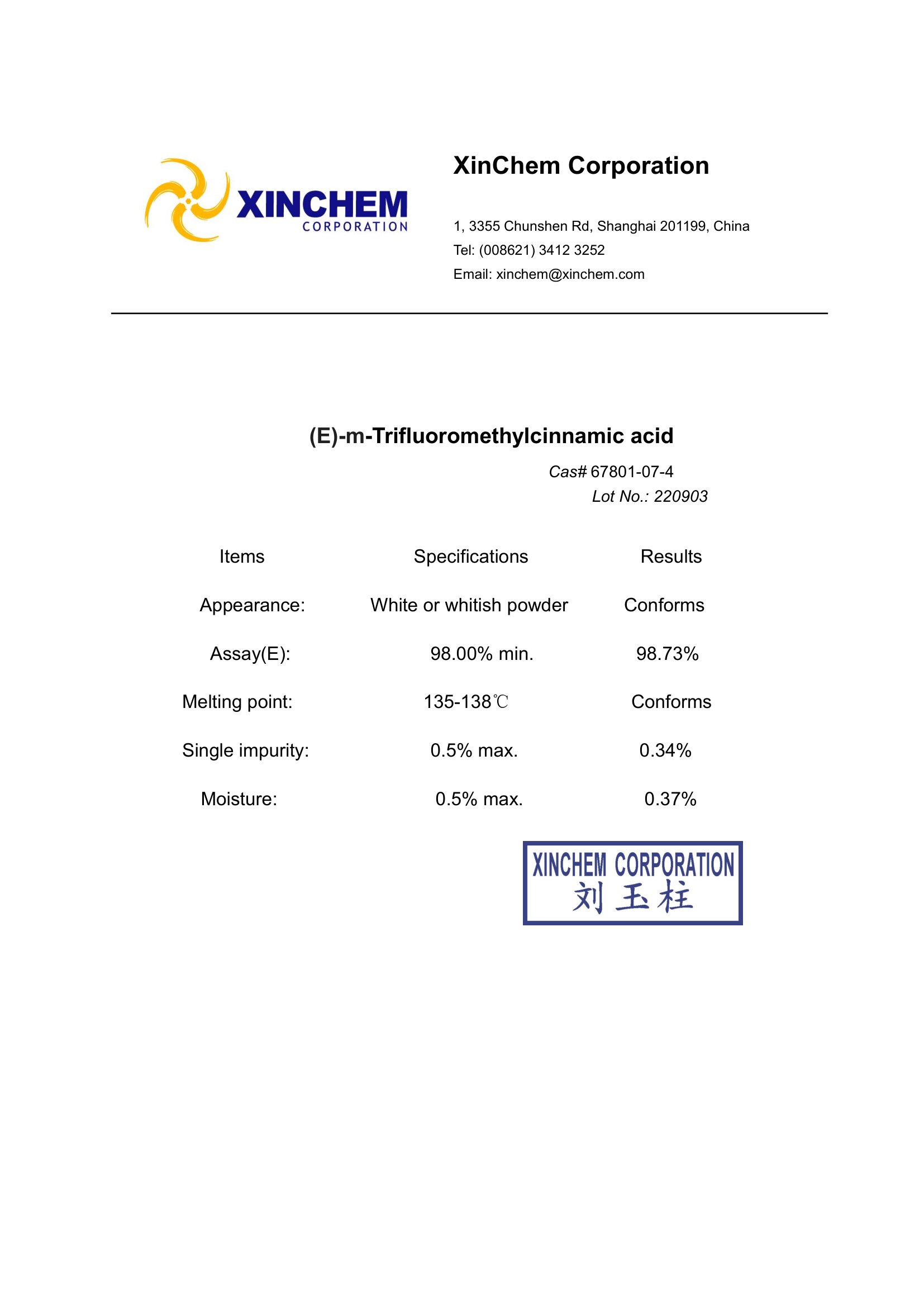
| CAS No. | 67801-07-4 |
| EINECS No. | 267-126-8 |
| IUPAC Name | (2E)-3-[3-(trifluoromethyl)phenyl]prop-2-enoic acid |
| Synonyms | (E)-m-(Trifluoromethyl)cinnamic acid; trans-3-(Trifluoromethyl)cinnamic acid; (E)-3-(3-(Trifluoromethyl)phenyl)acrylic acid |
| Molecular Formula | C₁₀H₇F₃O₂ |
| Molecular Weight | 216.16 g/mol |
| Appearance | White to off-white crystalline solid |
| Purity | 96% – 98% (commercial grades) |
| Melting Point | 135 – 136 °C |
| Boiling Point | 289.6±35.0 °C (Predicted) |
| Density | 1.363±0.06 g/cm³ (Predicted) |
| Refractive Index | 1.526 (Predicted) |
| Flash Point | 129 °C |
| Water Solubility | Slightly soluble |
| Solubility | Soluble in DMSO, methanol; slightly soluble in water |
| Log P (Predicted) | 2.8032 |
| PSA | 37.3 |
| InChI Key | KSBWHDDGWSYETA-SNAWJCMRSA-N |
| SMILES | C1=CC(=CC(=C1)C(F)(F)F)C=CC(=O)O |
| Storage | Store at room temperature in a dark, dry, well-ventilated area |
| Packaging | 10 g, 25 g, 100 g, 500 g, 1 kg, bulk containers |
1. Properties:
- Appearance and Physical Form: (E)-3-(Trifluoromethyl)cinnamic acid is supplied as a white to off-white crystalline solid. It is a high-purity compound (typically 96–98%) suitable for pharmaceutical R&D and chemical synthesis. The (E)-isomer is the biologically relevant and commercially predominant form.
- Solubility: The compound is soluble in DMSO (dimethyl sulfoxide) and methanol, and slightly soluble in water. It is expected to be soluble in other polar organic solvents such as ethanol, acetone, and ethyl acetate.
- Chemical Properties: (E)-3-(Trifluoromethyl)cinnamic acid is a fluorinated derivative of cinnamic acid, belonging to the class of (trifluoromethyl)benzenes. Its structure features a trans (E) double bond and a trifluoromethyl (-CF₃) group at the meta-position of the phenyl ring. The electron-withdrawing trifluoromethyl group enhances the compound’s lipophilicity and metabolic stability, which is advantageous in medicinal chemistry applications. As an α,β-unsaturated carboxylic acid, it exhibits reactivity typical of this class, including participation in Michael additions and polymerization reactions. The compound is characterized by a melting point of 135-136 °C, a boiling point of approximately 290 °C, and a density of 1.363 g/cm³. It has a predicted log P of 2.8032, indicating moderate lipophilicity.
2. Applications:
- Pharmaceutical Synthesis (Primary Application): (E)-3-(Trifluoromethyl)cinnamic acid is a key pharmaceutical intermediate and building block. It is notably used as a precursor in the synthesis of cinacalcet (Cinacalcet hydrochloride), a calcimimetic drug used to treat hyperparathyroidism. It serves as a critical intermediate in the production of this important pharmaceutical.
- Drug Discovery and Development: The compound is used in medicinal chemistry as a building block for the development of novel therapeutic agents. It has been studied as a precursor for novel antiplasmodial (antimalarial) and antibacterial agents. Its derivatives have been investigated for their potential in treating neurodegenerative diseases and as hepatoprotective agents.
- Organic Synthesis: As a fluorinated cinnamic acid derivative, it is a versatile building block for constructing conjugated systems and synthesizing various organic compounds. It can participate in a range of organic reactions, including Michael additions and polymerization.
- Agrochemical Research: Due to its fluorinated structure and metabolic stability, the compound is also valuable in the research and development of agrochemicals.
- Chemical Intermediate: The compound can be hydrogenated to produce m-trifluoromethylbenzyl acetic acid, another valuable intermediate.
3. Preparation Method:
- Laboratory/Industrial Synthesis: (E)-3-(Trifluoromethyl)cinnamic acid is typically synthesized via a Knoevenagel condensation reaction. The most common method involves the condensation of 3-(trifluoromethyl)benzaldehyde with malonic acid in the presence of a base. The reaction is typically carried out in pyridine as both solvent and base, with heating to drive the decarboxylative condensation. The product is isolated as the thermodynamically more stable trans (E) isomer.
4. Safety Information:
- Hazard Classification: (E)-3-(Trifluoromethyl)cinnamic acid is generally classified as a non-hazardous or low-hazard substance for transport and handling. As with all fine chemicals, standard laboratory safety practices should be followed. The compound may cause eye, skin, and respiratory tract irritation. It is recommended to avoid dust formation and use with adequate ventilation.
- First Aid Measures:
- Eye Contact: Rinse immediately with plenty of water for at least 15 minutes. Remove contact lenses if present. Seek medical attention if irritation persists.
- Skin Contact: Wash skin with plenty of soap and water. Remove contaminated clothing. Seek medical advice if irritation develops.
- Inhalation: Move person to fresh air. If symptoms persist, seek medical advice.
- Ingestion: Rinse mouth. Do NOT induce vomiting. Seek immediate medical attention if a large amount is ingested.
- Personal Protective Equipment (PPE): Wear chemical-resistant gloves, safety goggles, and protective clothing. Use in a well-ventilated area (fume hood). Avoid breathing dust.
- Storage & Stability: Store at room temperature in a tightly closed container. Keep in a dark, cool, dry, well-ventilated area away from incompatible materials (strong oxidizing agents, strong bases). Under recommended storage conditions, the compound has a shelf life of several years.
- Regulatory Compliance: This compound is for research and development use only. It is not intended for human or veterinary therapeutic use. It is listed on EINECS (267-126-8), TSCA, and other regional chemical inventories. Always consult the Safety Data Sheet (SDS) for complete safety and regulatory information.
Write your message here and send it to us