
Hydroxypropyl Starch(CAS#9049-76-7)–Fluid Loss Reducer & Viscosifier for Drilling Fluids
1. Properties:
- Appearance and Physical Form: Hydroxypropyl starch (HPS) is supplied as a white to off‑white free‑flowing powder. Drilling and construction grades are off‑white to cream, while high‑purity pharmaceutical and food grades are bright white. The powder is odourless, disperses readily in cold water, and forms a transparent to translucent viscous colloid upon heating (gelatinization temperature ~60°C, significantly lower than native starch at ~80°C).
- Solubility: HPS is insoluble in cold water in its powdered form but forms a transparent viscous colloid when heated. Unlike native starch, HPS disperses readily in cold water without clumping and fully hydrates upon heating to 60–80°C, forming a clear, stable, viscous solution. The product is also compatible with most polar organic solvents and can be formulated into non‑aqueous systems when required.
- Chemical Properties: Hydroxypropyl starch is a non‑ionic starch ether produced by reacting natural starch (derived from corn, tapioca, potato, or wheat) with propylene oxide (1,2-epoxypropane) under alkaline conditions. During etherification, hydroxypropyl groups (–CH₂–CH(OH)–CH₃) are introduced onto the hydroxyl (–OH) groups of the starch polymer backbone via an ether linkage. This modification disrupts the crystalline structure of native starch, enhancing cold water solubility, reducing retrogradation (syneresis prevention), improving freeze‑thaw stability, increasing enzymatic resistance, and providing superior thermal and shear stability.
- Mechanism of Action in Drilling Fluids: When added to water‑based drilling fluids, HPS hydrates and swells, forming a structured polymer network through hydrogen bonding and polymer entanglement. This network, combined with fine solid particles, creates a thin, low‑permeability filter cake on the wellbore wall, reducing filtrate loss into permeable formations and stabilizing the borehole. The non‑ionic nature of HPS ensures that its performance is only slightly affected by salinity, water hardness, and pH variations, making it highly effective in seawater, brine, and high‑salinity drilling environments.
- Comparison with Native Starch: Native starch exhibits limited thermal stability (degrades above 80°C), poor freeze‑thaw stability (≤2 cycles), and significant viscosity variation (±25% across pH 3–9). In contrast, HPS maintains thermal stability at 90–120°C processing temperatures, provides ≥5 freeze‑thaw cycles without syneresis, and delivers ≤5% viscosity variation across pH 3–9, making it a superior alternative for demanding oilfield, food, and industrial applications.
- Thermal Stability: HPS exhibits excellent thermal stability, maintaining viscosity at 90–120°C processing temperatures—a significant improvement over native starch which degrades rapidly above 80°C. Under high‑shear conditions commonly encountered in drilling operations and industrial mixing, HPS experiences ≤15% viscosity loss, ensuring consistent performance in high‑speed, high‑shear environments.
- pH Tolerance: HPS maintains stable performance across a wide pH range of 3–11, making it suitable for acidic food products, neutral drilling fluids, and alkaline industrial formulations.
- Freeze‑Thaw Stability: HPS withstands ≥5 freeze‑thaw cycles without syneresis (water separation), whereas native starch fails after ≤2 cycles. The viscosity variation of HPS across repeated freeze‑thaw cycles is only ±5%, compared to ±25% for native starch, ensuring consistent texture and stability in frozen food products.
- Film Formation: HPS forms oxygen‑impermeable edible films with thicknesses of 25–50 μm, providing effective oxygen barriers for food preservation, pharmaceutical coating, and agricultural seed coating applications.
- Biodegradability: As a modified natural polymer derived from renewable starch sources, HPS is readily biodegradable, offering an environmentally friendly alternative to synthetic polymers in drilling, water treatment, and consumer applications.
2. Applications:
Oil & Gas Industry – Drilling and Well Construction (Primary Fluid Loss Control):
- Water‑Based Drilling Fluids (WBM): HPS is widely used as a primary fluid loss control agent and rheology stabilizer in water‑based drilling muds. It forms a thin, low‑permeability filter cake that stabilizes the wellbore, reduces filtrate invasion into permeable formations, and maintains borehole integrity. The non‑ionic structure ensures excellent salt tolerance and hardness resistance, making HPS effective in freshwater, seawater, and high‑salinity drilling environments. Recommended dosage: 0.2–0.5% by weight of fluid, often used in combination with PAC, CMC, or bentonite.
- Drill‑In, Completion and Workover Fluids: HPS is a preferred additive for drill‑in fluids, completion brines, and workover fluids, where filter cake residue can damage the reservoir formation. The thin, deformable filter cake is easily removed during well clean‑up and production start‑up, minimizing formation damage and protecting the pay zone.
- Cementing Slurries (Well Cementing): Hydroxypropyl starch functions as a fluid loss control additive and viscosity modifier in oil well cementing operations, reducing filtrate invasion into permeable formations, preventing gas migration, and ensuring a reliable cement sheath for long‑term zonal isolation.
- Filtration Control Mechanism: HPS reduces filtrate loss by physically plugging pore throats and formation openings while also increasing the viscosity of the filtrate phase. The polymer swells in water, bridging across pore spaces and forming a compressible, deformable filter cake that maintains structural integrity under differential pressure.
- Rheology Stabilization: HPS helps maintain optimal viscosity, yield point, and gel strength under downhole conditions, improving cuttings suspension, hole cleaning, and preventing barite sag in weighted mud systems.
- Lubricity Enhancement: HPS improves the flow behaviour of drilling fluids and reduces friction between the drill string and the borehole wall, lowering torque and drag in directional and horizontal drilling operations.
Food Industry – Thickener, Stabilizer and Texturizer (E1440):
- Frozen Desserts and Ice Cream: HPS (E1440) is used as a thickening and stabilizing agent in frozen desserts and ice cream to control ice crystal formation, improve texture, and prevent syneresis (water separation) during freeze‑thaw cycling. The modified starch provides excellent freeze‑thaw stability (≥5 cycles), ensuring consistent quality throughout frozen storage.
- Sauces, Gravies and Dressings: HPS provides smooth, thickened surfaces without a granular texture, offering excellent heat, acid, and shear stability for high‑temperature processing and long shelf‑life products including canned soups, sauces, salad dressings, ketchup, and barbecue sauce.
- Bakery and Dough Products: In bread, cakes, pastries, and dumplings, HPS improves dough workability, water retention, and freeze‑thaw stability, maintaining freshness and extending product shelf life. When used at 0.8% in dough formulations, HPS achieves up to 60% reduction in product rejection rates.
- Dairy Products and Processed Cheese: HPS functions as a thickening and stabilizing agent in yoghurt, puddings, custards, processed cheese, cheese spreads, and sour cream, improving mouthfeel, preventing syneresis, and providing uniform texture without masking flavour.
- Mayonnaise and Emulsions: HPS provides viscosity, stability, and emulsion‑holding capacity in mayonnaise, dressings, and other oil‑in‑water emulsions.
- Canned and Processed Foods: HPS is used in canned vegetables, canned fish (sardines), fish sticks, ready meals, instant noodles, and canned meat products to maintain texture, prevent separation, and improve overall product stability under retort processing conditions.
- Gluten‑Free and Clean‑Label Formulations: As a clean‑label, non‑allergenic, plant‑based ingredient, HPS is particularly valued in gluten‑free bakery, vegan, and organic product formulations.
Pharmaceutical Industry – Excipient and Formulation Aid:
- Tablet Binder and Disintegrant: HPS is used in pharmaceutical tablet formulations as a binding agent and disintegrant. It provides rapid disintegration (30–60 seconds), promoting faster drug release upon ingestion. Tablet hardness, cohesion, and dissolution profiles are improved without compromising stability.
- Vegan Capsule Shells: Hydroxypropyl starch is used to produce gelatin‑free, vegan capsule shells (HPSC – Hydroxypropyl Starch Capsules) for pharmaceutical and nutraceutical applications. These capsules meet USP requirements with 45‑second disintegration times, offering a plant‑based alternative to animal‑derived gelatin.
- Controlled‑Release Excipient: HPS is used as a sustained‑release matrix former and granulation binder in oral solid dosage forms, providing prolonged drug release profiles for extended‑release formulations.
Cosmetics & Personal Care – Thickener and Rheology Modifier:
- Natural Thickener in Shampoos and Body Washes: Hydroxypropyl starch phosphate (a derivative of HPS) is widely used as a biodegradable thickening agent and rheology modifier in shampoos, liquid soaps, and body washes. It builds viscosity, improves foam stability, and creates a creamy, luxurious feel. It has a lower gelatinization temperature (~60°C) than native starches (~80°C), allowing for easier processing.
- Creams, Lotions and Gels: HPS functions as a thickener, emulsion stabilizer, and skin‑conditioning agent in face creams, moisturising lotions, sunscreens, and anti‑ageing serums. It provides smooth, creamy texture, enhances spreadability, and delivers a pleasant, non‑greasy skin feel without heavy or sticky residue.
- Hair Conditioners: HPS improves slip, detangling properties, and conditioning performance in hair conditioners and leave‑in treatments, leaving hair smooth, manageable, and healthy‑looking. It is compatible with both anionic and cationic surfactant systems.
- Facial Cleansers and Scrubs: HPS acts as a texturiser, gentle exfoliant, and viscosity‑building agent in facial cleansers, exfoliating scrubs, and face washes, offering a natural, biodegradable alternative to synthetic polymers and microbeads.
- Makeup and Colour Cosmetics: Hydroxypropyl starch provides consistency, skin adhesion, and pigment binding in foundations, pressed powders, blushes, and eyeshadows, improving wear and feel without caking or flaking.
- Biodegradable and Natural Formulations: As a plant‑derived, non‑GMO, naturally biodegradable ingredient, HPS is ideal for natural, organic, clean‑beauty, and microplastic‑free cosmetic formulations.
Construction and Building Materials:
- Dry‑Mix Mortars and Tile Adhesives: HPS acts as a thickening agent, water‑retention aid, and anti‑sagging additive in cement‑based and gypsum‑based dry‑mix mortars, tile adhesives, wall putties, plasters, and self‑leveling compounds. It improves workability, open time, adhesion, and slip resistance for large tiles applied to vertical surfaces.
- Gypsum Plasters and Joint Compounds: HPS enhances spreadability, surface smoothness, and water retention in plaster formulations, reducing tool stickiness and improving finishing characteristics.
- Cement and Concrete Additives: HPS functions as a water‑retention aid and rheology modifier in cement‑based formulations, reducing cracking and improving final strength development.
Textile & Paper Industry:
- Textile Warp Sizing: HPS is used in textile warp sizing compositions to improve the wear resistance of fibres, reduce yarn breakage during weaving, and enhance fabric quality. It offers 30% reduction in fibre breakage compared to unsized yarns.
- Paper Coating and Surface Sizing: HPS is used as a surface sizing agent and paper coating binder to enhance surface strength, ink absorption rate (15–20 g/m²), and printability. It improves paper smoothness, gloss, and resistance to ink feathering.
Other Industrial Applications:
- Water Treatment: HPS functions as a flocculant and coagulant aid in industrial wastewater treatment and sludge dewatering operations, improving solids capture and reducing turbidity.
- Agricultural Adjuvants: HPS is used as a thickening and suspending agent in pesticide formulations, seed coatings, and liquid fertilisers, improving spray coverage, rainfastness, and active ingredient retention.
- Oilfield Drilling Aids: HPS is compatible with saltwater, seawater, and high‑salinity brines used in drilling, completion, and workover fluids, maintaining stable viscosity and filtration control even under high electrolyte concentrations.
- Compatibility: HPS is compatible with most drilling fluid additives including PAC, CMC, bentonite, barite, polymers, biocides, corrosion inhibitors, and scale inhibitors.
3. Preparation Method:
- Laboratory Method: HPS can be prepared in the laboratory using a solvent or aqueous method. Solvent method: Starch is dispersed in a water‑miscible organic solvent (isopropanol or ethanol) in a stirred reactor. Sodium hydroxide (NaOH) is added to activate the starch hydroxyl groups, followed by dropwise addition of propylene oxide (1,2‑epoxypropane). The reaction mixture is heated to 50–60°C for 4–8 hours. The product is neutralised with acetic or phosphoric acid, filtered, washed with aqueous alcohol, dried at 50–60°C, and milled to the desired particle size.
- Industrial Process: Industrial production of high‑quality HPS follows a large‑scale solvent‑phase or aqueous‑phase etherification process:
- Raw Material Preparation: Natural starch (from corn, tapioca, potato, or wheat) is milled and dried to a standardised moisture content.
- Alkaline Activation: The starch is slurried in water or a water‑miscible organic solvent (isopropanol) and treated with sodium hydroxide to swell the starch granules and activate the hydroxyl groups for etherification.
- Etherification: Propylene oxide is added to the activated starch slurry under controlled pressure and temperature (50–70°C). The reaction proceeds for 6–12 hours, during which hydroxypropyl groups are covalently attached to the starch polymer backbone via ether linkages.
- Neutralisation: The alkaline reaction mixture is neutralised with an acid (phosphoric acid, hydrochloric acid, or acetic acid) to pH 8.0–10.5 (drilling grade) or 5.0–7.5 (food grade).
- Purification: The crude product is washed with aqueous alcohol solutions to remove unreacted propylene oxide, inorganic salts (sodium chloride, sodium acetate), and low molecular weight byproducts.
- Drying and Milling: The purified HPS is dried in flash dryers or fluidised bed dryers to ≤10% moisture content, then milled and sieved to the desired particle size (≥95% passing through 80 mesh or finer).
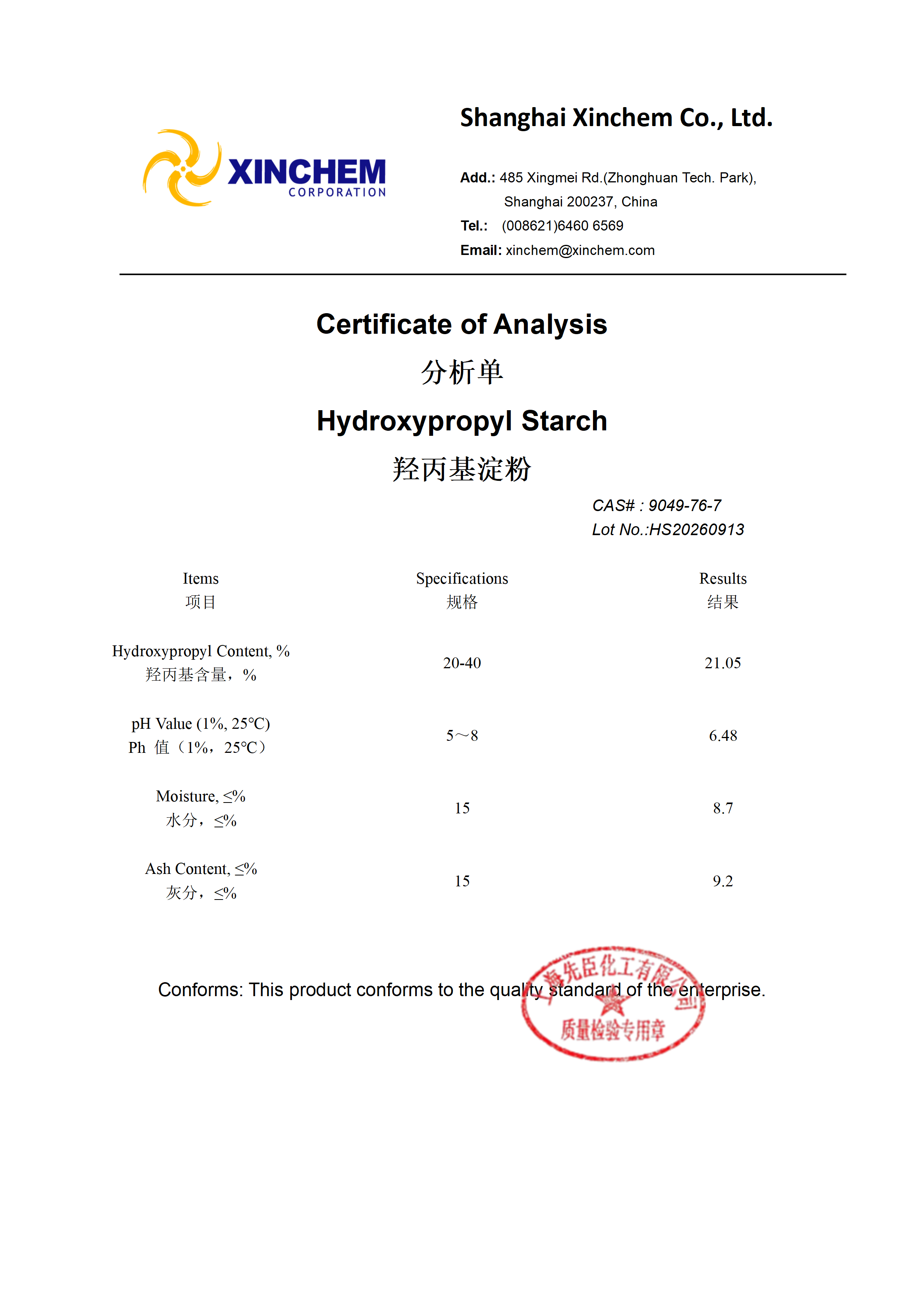
- Quality Control: Key parameters analysed include hydroxypropyl content (by gas chromatography or UV spectrophotometry after derivatisation), degree of substitution (DS, typically 0.05–0.15 for food grade), viscosity (Brookfield viscometer, 5% aq., 20°C), moisture (Karl Fischer or oven drying), pH (1% or 5% aq. solution), ash content (gravimetric), particle size distribution (sieving or laser diffraction), and microbial limits (for food/pharmaceutical grades).
- Packaging: The final product is packaged in 25 kg multi‑wall moisture‑proof bags with polyethylene liners, 500–1000 kg FIBC (jumbo bags), or bulk containers. Custom packaging options are available for food‑grade, pharmaceutical‑grade, and drilling‑grade specifications.
4. Safety Information:
- Hazard Classification: Hydroxypropyl starch is generally classified as a non‑hazardous or very low hazard product under GHS/CLP Regulation (EC) No 1272/2008. The substance is not classified as dangerous for transport under most regulatory schemes (UN number not assigned). No hazard pictograms or signal word are required for most commercial grades. The product is not flammable, explosive, or environmentally hazardous under standard criteria. However, high dust concentrations may carry hazard statement H335 (May cause respiratory irritation). The substance does not meet the criteria for vPvB (very persistent, very bioaccumulative) or PBT (persistent, bioaccumulative, toxic) substances.
- Health Hazards:
- Inhalation: Inhalation of airborne HPS dust may cause mild respiratory tract irritation, coughing, sneezing, or throat discomfort in sensitive individuals. Prolonged or repeated exposure to high dust concentrations may cause respiratory discomfort.
- Skin Contact: Generally non‑irritating to intact skin. Prolonged or repeated contact may cause mild mechanical irritation or drying due to the abrasive effect of the powder.
- Eye Contact: May cause mild mechanical irritation due to dust particles. Rinse with water.
- Ingestion: Low acute oral toxicity (LD₅₀ oral > 5,000 mg/kg in rats). HPS is not absorbed systemically from the gastrointestinal tract and is generally regarded as safe (GRAS) for human consumption as a food additive (E1440). Ingestion of large amounts may cause mild gastrointestinal discomfort due to bulking effect.
- First Aid Measures:
- Eye Contact: Rinse cautiously with plenty of water for several minutes. Remove contact lenses if present and easy to do. If eye irritation persists, seek medical attention.
- Skin Contact: Wash skin with plenty of soap and water. Remove contaminated clothing. Seek medical advice if skin irritation develops.
- Inhalation: Move person to fresh air. Keep at rest in a position comfortable for breathing. If symptoms (coughing, throat irritation) persist, seek medical advice.
- Ingestion: Rinse mouth immediately. Do NOT induce vomiting. Drink water to dilute if conscious and able to swallow. Seek medical attention if a large amount is ingested or if symptoms develop.
- Personal Protective Equipment (PPE):
- Respiratory protection: Use a dust mask (N95 or P2 respirator) if airborne dust concentrations are present or when handling powder grades in poorly ventilated areas.
- Eye protection: Safety goggles or dust‑resistant safety glasses to prevent mechanical eye irritation from dust particles.
- Skin protection: Protective gloves (nitrile or neoprene) and laboratory coat recommended to minimise skin contact and dust exposure.
- General hygiene: Wash hands thoroughly after handling. Do not eat, drink, or smoke in work areas. Minimise dust generation and avoid breathing dust. Use good industrial hygiene practices.
- Fire & Explosion Hazards: Hydroxypropyl starch is not combustible but may burn if involved in a fire. Accumulated settled dust may form explosive concentrations in air when disturbed and dispersed, as with any organic dust. In case of fire, use water spray, foam, dry powder, or CO₂ as extinguishing media appropriate for the surrounding fire. Thermal decomposition may produce irritating and toxic fumes including carbon monoxide (CO), carbon dioxide (CO₂), and low molecular weight organic compounds.
- Environmental Precautions: HPS is readily biodegradable as a modified natural polymer derived from renewable starch sources. The product is not classified as hazardous to the aquatic environment under most regulatory schemes. However, avoid large‑scale release into natural water bodies, drains, or soil. Comply with local environmental regulations for disposal.
- Storage & Stability: Store in tightly closed, moisture‑proof containers in a cool, dry, well‑ventilated area away from direct sunlight, heat sources, and strong oxidising agents. HPS is hygroscopic; exposure to atmospheric moisture leads to caking, lump formation, and reduced functional performance. Under recommended storage conditions (room temperature, low humidity, <30°C), HPS has a shelf life of 12–24 months from the date of manufacture in sealed original containers.
- Regulatory Compliance: Hydroxypropyl starch (CAS#9049-76-7, EINECS 269-212-0) is listed on EINECS, TSCA, DSL, AICS, NZIoC, ENCS, KECI, and other regional chemical inventories.
- US FDA Food Regulations: HPS is affirmed as GRAS (Generally Recognized as Safe) under 21 CFR §172.892 for use as a direct food additive. It is also permitted as a substance added to food (EAFUS inventory) as “Hydroxypropyl starch” and is listed in the FDA’s Inventory of Food Contact Substances.
- EU Food Additive Status: HPS is authorised as a food additive under the designation E1440 pursuant to Regulation (EC) No 1333/2008 and meets the purity criteria set out in Commission Regulation (EU) No 231/2012. It is approved for use in food products across the European Union.
- JECFA (Joint FAO/WHO Expert Committee on Food Additives): HPS has an ADI (Acceptable Daily Intake) of “not specified,” the highest safety category indicating no safety concern at any level of intake.
- Pharmaceutical Compliance: Pharmaceutical grades of HPS conform to USP/NF (United States Pharmacopeia/National Formulary) and Ph. Eur. (European Pharmacopoeia) monographs where applicable.
- Drilling Grade Compliance: Drilling‑grade HPS meets API specifications for fluid loss control additives in water‑based drilling fluids and is compatible with most oilfield chemical regulatory requirements.
- Kosher / Halal / Allergen‑Free: Kosher, Halal, and allergen‑free certifications are available for food and pharmaceutical grades upon request.
Always consult the Safety Data Sheet (SDS) and local regulations for complete safety, environmental, and regulatory information specific to each product grade and application jurisdiction.
Write your message here and send it to us
![(3S,7aR)-3-(trichloroMethyl)tetrahydropyrrolo[1,2-c]oxazol-1(3H)-one(CAS#1330286-50-4)](https://www.xinchem.com/uploads/3-trichloroMethyltetrahydropyrrolo12-coxazol-13H-one.gif)