
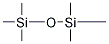
Polydimethylsiloxane PDMS Defoamer(CAS#9006-65-9)–Silicone Antifoam for Industrial Foam Control
1. Properties:
- Appearance and Physical Form: Polydimethylsiloxane (PDMS) defoamer is supplied as a colourless to light yellow transparent viscous liquid when delivered as the 100% active neat oil, or as a white milky liquid when formulated as a water‑based emulsion (2–60% active). The neat oil has a mild, low‑volatility odour and exhibits a syrupy consistency.
- Solubility: PDMS defoamer is practically immiscible with water and ethanol, but fully soluble in most organic solvents including aliphatic and aromatic hydrocarbons, chlorohydrocarbons, ethers, esters, ketones, and higher alcohols. Water‑based emulsions are readily water‑dispersible with gentle agitation, forming a good dispersion for easy incorporation into aqueous processes.
- Chemical Properties: PDMS is a linear, non‑reactive silicone polymer (poly(dimethylsiloxane)) consisting of repeating [Si(CH₃)₂O] units with a unique alternating silicon–oxygen backbone. This structure imparts exceptionally low surface tension (~20–22 mN/m), outstanding spreading capability, excellent water‑repellent properties, high compressibility, good dielectric properties, and high surface activity.
- Defoaming Mechanism: When added to a foaming system at concentrations as low as 10–100 ppm, PDMS spreads rapidly across the gas‑liquid interface, displacing foam‑stabilising surfactants and creating a surface tension gradient (Marangoni effect) that causes the foam lamellae to thin and rupture. The dual action provides both immediate foam knockdown and persistent foam suppression.
- Thermal Stability: PDMS maintains performance from –50°C to +200°C, making it suitable for both cold‑weather and high‑temperature applications. High‑viscosity grades (e.g., WACKER® AK 1000000) have flash points up to 320°C and ignition temperatures up to 450°C.
- Chemical Inertness and Compatibility: PDMS is non‑corrosive to metals, resistant to hydrolysis and oxidation, and compatible with most industrial base fluids including mineral oils, synthetic lubricants, and surfactant systems. It does not interfere with cement hydration or additive performance.
- Environmental Profile: PDMS does not bioaccumulate in sediment‑dwelling organisms or terrestrial species, including earthworms, and is not considered hazardous to the environment under normal handling conditions.
2. Applications:
Oil & Gas Industry – Oil Well Cementing (Primary Application):
- Cement Slurry Defoamer: PDMS defoamer is a critical additive in oil well cementing operations to eliminate foam introduced during high‑speed mixing. Uncontrolled foam in cement slurries can reduce slurry density by 0.5 to 1.5 lb/gal (60 to 180 kg/m³), significantly distorting hydrostatic calculations, weakening set cement compressive strength, and compromising zonal isolation. PDMS defoamer restores designed density and prevents gas/water channeling.
- Drilling Fluids and Mud Systems: Emulsified PDMS compounds are used at treat rates of 10–100 ppm (0.001%–0.01%) in water‑based drilling fluids to control entrained air and foam that would otherwise reduce pump efficiency, interfere with solids control equipment, and cause inaccurate pit volume readings.
- Crude Oil Processing and Refining: PDMS defoamer prevents or cures foam formation in crude oil processing and storage facilities, gas treatment units, desalting systems, and water treatment trains, improving oil‑water separation efficiency and meeting BS&W specifications.
- Fracturing Fluids and Completion Brines: Used as a foam suppressant in hydraulic fracturing operations where foam would hinder accurate blending, proppant suspension, and fracture conductivity.
Water & Wastewater Treatment:
- Industrial and Municipal Wastewater: PDMS defoamer is used to control foam in aeration basins, clarifiers, sludge handling systems, and final effluent channels. Effective at low concentrations (5–100 ppm), it prevents overflow and reduces maintenance costs.
- Cooling Tower Water Treatment: Controls foam in recirculating cooling water systems caused by surfactant carryover, biological activity, and process leaks. PDMS emulsions are particularly effective in high‑temperature, high‑hardness water systems.
Food & Beverage Processing:
- Direct and Indirect Food Additive (FDA 21 CFR 173.340): PDMS defoamer is approved as a direct food additive at levels up to 10 ppm active silicone solids. Applications include meat and poultry processing (scald tanks, wash water), fruit and juice processing, pickling, rice processing, potato washing, soft drinks, instant coffee, edible oil refining, and sugar refining.
- Food Packaging and Contact Materials: PDMS defoamer complies with indirect food additive regulations for adhesives (21 CFR 175.105), paper and paperboard coatings (176.170, 176.180, 176.200, 176.210), and food contact surfaces in packaging manufacturing.
Paints, Coatings & Inks:
- Water‑Based Paints and Coatings: PDMS defoamer eliminates surface foam defects (cratering, pinholes, fish eyes, orange peel) during paint manufacture and application without affecting coating adhesion, gloss, or weather resistance.
- Printing Inks and Pigment Dispersions: Provides foam control in water‑based flexographic, gravure, and UV‑curable inks, ensuring consistent print quality and uniform pigment transfer.
Metalworking Fluids (MWF) and Industrial Lubricants:
- Cutting, Grinding and Rolling Fluids: PDMS defoamer is incorporated into soluble oils, semi‑synthetic, and synthetic metalworking fluids to suppress foam build‑up that would otherwise reduce cooling, lubrication, and chip‑settling efficiency.
- Hydraulic Fluids and Gear Oils: Functions as a foam suppressant and anti‑foam additive in petroleum lubricating oils, hydraulic fluids, and compressor lubricants.
Textile Industry:
- Textile Printing and Dyeing: PDMS defoamer eliminates foam in printing pastes and dye baths, ensuring sharp pattern definition, uniform colour transfer, and reduced fabric reject rates. It is effective in jet dyeing machines where foam can cause fabric damage and uneven dyeing.
- Fiber Finishes and Sizing Baths: Added to sizing and finishing baths to prevent foam interference and ensure uniform application of chemical auxiliaries.
Pulp & Paper Industry:
- Paper Machine White Water Systems: PDMS defoamer controls foam in paper machine wet ends, white water loops, pulp washing, and coating formulations, improving drainage, sheet formation, and reducing sheet defects.
- De‑inking and Recycling: Prevents foam carryover in de‑inking processes and flotation cells.
Detergents & Cleaning Formulations:
- Liquid Laundry Detergents and Fabric Softeners: PDMS defoamer functions as a foam suppressant in concentrated and standard liquid detergents, improving rinsing efficiency and reducing water consumption.
- Automatic Dishwashing Rinse Aids: Provides sheeting action and foam control in rinse aid formulations without leaving residues.
- Industrial Cleaners and CIP Formulations: Effective in high‑temperature, high‑shear cleaning operations for food, dairy, and beverage equipment.
Agrochemicals:
- Spray Adjuvants and Tank Mixes: PDMS defoamer is added to herbicide, insecticide, and fungicide spray solutions to prevent foam that would otherwise reduce pump efficiency and spray coverage.
- Fertiliser Suspensions: Controls foam during mixing and application of liquid fertilisers and suspension concentrates.
Fermentation & Bioprocessing:
- Microbial Fermentation: PDMS defoamer (activated dimethicone) is used to control foam in aerobic and anaerobic fermentation processes for antibiotics, enzymes, organic acids, yeast, biofuels, and bioproducts. It does not inhibit microbial growth or interfere with oxygen transfer at recommended use levels.
- Cell Culture and Biopharmaceutical Processing: Biocompatible PDMS grades are suitable for pharmaceutical and biotechnology applications where foam would compromise sterile conditions or reduce yield.
Plastics, Adhesives & Polymer Processing:
- Plastics Additive and Processing Aid: PDMS functions as a processing aid, lubricant, and anti‑block agent in plastic extrusion, injection moulding, and masterbatch compounding.
- Adhesives and Sealants: Used as a defoamer and processing aid in water‑based and solvent‑based adhesive formulations for packaging, construction, and food contact applications.
- Polymerisation and Monomer Stripping: PDMS antifoam emulsion is used in monomer stripping, latex manufacturing, and polymerisation processes to control foam.
Other Industrial Applications:
- Mining and Mineral Processing: Controls foam in flotation circuits, slurry transport, and tailings treatment.
- Petrochemicals: Used in delayed coker feedstocks and preflash tower units to control hydrocarbon foam.
- Fire Fighting Foams: Antifoam agents for controlling foam in firefighting systems.
- Cosmetics: Functions as an emollient, skin protectant, and antifoam agent in cosmetic formulations (dimethicone USP grade).
- Mold Release Agent: PDMS silicone oil functions as an effective release agent for rubber, plastic, and metal moulding operations.
- Paper Coatings: Defoamer in paper coating formulations for smooth, defect‑free surfaces.
- Adhesive Manufacturing: Used as a processing aid in the manufacture of hot‑melt and water‑based adhesives.
3. Preparation Method:
- Laboratory Method: PDMS is not typically synthesised in the laboratory for defoamer applications but can be prepared by ring‑opening polymerisation of octamethylcyclotetrasiloxane (D₄) using an acid or base catalyst. The molecular weight and viscosity are controlled by the ratio of monomer to chain‑terminating agent (hexamethyldisiloxane).
- Industrial Process: Industrial production of PDMS defoamer follows a large‑scale continuous process:
- Polymerisation: Cyclic siloxane monomers (mainly octamethylcyclotetrasiloxane, D₄) and a chain terminator are reacted in the presence of an acid or base catalyst at 100–160°C in a stirred reactor, yielding a linear PDMS polymer of controlled viscosity.
- Emulsification (for emulsion grades): The PDMS oil is emulsified in water using non‑ionic and/or anionic surfactants under high‑shear mixing to produce a stable, white, aqueous emulsion with active contents ranging from 2% to 60% (common grades: 10%, 20%, 30%). Key emulsion parameters include:
- Particle size: 90% <100 microns
- Viscosity (30% emulsion, 25°C): 800–2500 cps
- pH (1% in 50:50 IPA:H₂O): 4.0–7.0
- Compounding (optional): PDMS may be compounded with hydrophobic silica particles (treated fumed silica) to enhance defoaming performance in aggressive foaming systems. This activated PDMS is known as simethicone (PDMS + silica gel) for pharmaceutical, fermentation, and food applications.
- Quality Control: Key specifications analysed include active content (by loss on drying), viscosity (rotational viscometer), pH, emulsion stability (centrifuge test), particle size distribution, flash point, density, surface tension, and residual monomer content.
- Packaging: The final product is packaged in 25 kg drums, 200 kg drums, 1000 kg IBC totes, or bulk road tankers. Recommended storage is in sealed, moisture‑proof containers at room temperature. Emulsion grades must be protected from freezing, and neat oils should be stored away from direct sunlight and strong oxidising agents.
4. Safety Information:
- Hazard Classification: According to GHS/CLP Regulation (EC) No 1272/2008, PDMS defoamer is generally classified as a low‑hazard or non‑hazardous product. The product is not classified as hazardous according to the criteria of the Globally Harmonised System (GHS) for most grades, and is not classified as Dangerous Goods for transport by road, rail, sea, or air. Some formulations may carry hazard statement H413 (May cause long‑lasting harmful effects to aquatic life). Signal word: Not applicable for most grades. Hazard pictogram: None (for most grades). UN Number: Not assigned for most grades. The product is non‑flammable under standard conditions, non‑toxic, and does not meet the criteria for vPvB or PBT substances.
- Health Hazards:
- Inhalation: Inhalation of mists or vapours may cause mild respiratory tract irritation, coughing, or throat discomfort in sensitive individuals. No emergency care is anticipated under normal handling conditions.
- Skin Contact: Generally non‑irritating to intact skin; prolonged or repeated contact may cause mild irritation or drying in sensitive individuals. Wash affected skin with soap and water; remove contaminated clothing.
- Eye Contact: May cause mild transient mechanical irritation. Immediately irrigate with copious quantities of water for at least 15 minutes; hold eyelids open.
- Ingestion: Low acute oral toxicity. If swallowed, rinse mouth with water, then give water to drink. Do NOT induce vomiting. Seek medical assistance if large amount is ingested or if symptoms develop.
- First Aid Measures:
- Eye Contact: Immediately flush eyes with plenty of water for at least 15 minutes. Remove contact lenses if present and easy to do. Seek medical attention if irritation persists.
- Skin Contact: Wash skin with plenty of soap and water. Remove contaminated clothing. If skin irritation develops, seek medical advice.
- Inhalation: Move person to fresh air. Keep at rest in a position comfortable for breathing. If symptoms (coughing, throat irritation) persist, seek medical advice.
- Ingestion: Rinse mouth immediately. Do NOT induce vomiting. Drink water to dilute if conscious and able to swallow. Seek medical attention if a large amount is ingested or if symptoms develop.
- Personal Protective Equipment (PPE):
- Respiratory protection: Not normally required under good ventilation. In poorly ventilated areas or during mist‑producing operations, use a dust/mist respirator (N95 or P2).
- Eye protection: Safety glasses or chemical splash goggles recommended to protect from splashing.
- Skin protection: Protective gloves (nitrile or neoprene) to minimise prolonged skin contact.
- General hygiene: Wash hands thoroughly after handling. Do not eat, drink, or smoke in work areas. Use standard industrial hygiene practices.
- Fire & Explosion Hazards: PDMS neat oil is not classified as flammable but is combustible. Water‑based emulsions are non‑flammable. Thermal decomposition may release irritating and toxic fumes including carbon monoxide (CO), carbon dioxide (CO₂), and silicon oxides (SiOₓ). Use water spray, foam, dry chemical powder, or carbon dioxide as extinguishing media appropriate for the surrounding fire. In the event of fire, prevent fire extinguishing water from contaminating surface water or groundwater systems.
- Environmental Precautions: PDMS is considered to be of low environmental concern. It does not bioaccumulate in sediment‑dwelling organisms or various terrestrial species, including earthworms. However, avoid large‑scale release into natural water bodies, drains, or soil. In case of spillage, contain with inert material (sand, vermiculite, diatomaceous earth) and dispose of in accordance with local regulations.
- Storage & Stability: Store in tightly closed, moisture‑proof containers in a cool, dry, well‑ventilated area away from direct sunlight, heat sources (max. 50°C), and strong oxidising agents. PDMS has excellent storage stability when stored under these conditions. For emulsion grades: Store in closed containers; protect from freezing. If frozen, warm to 20–30°C and stir gently to restore emulsion homogeneity. For neat oil grades: Shelf life of 12–36 months from date of manufacture in sealed original containers. Under recommended storage conditions, the product maintains its properties for the stated shelf life.
- Regulatory Compliance: PDMS (Polydimethylsiloxane, CAS#9006-65-9) is listed on EINECS (269-212-0), TSCA, DSL, AICS, NZIoC, ENCS, KECI, and other regional chemical inventories.
- US FDA Food Regulations: PDMS defoamer is approved as a direct food additive under 21 CFR 173.340 (defoaming agents in food processing) at levels up to 10 ppm active silicone solids. It also complies with indirect food additive regulations for adhesives and food packaging: 21 CFR 175.105 (adhesives), 176.170 (paper and paperboard in contact with aqueous/fatty foods), 176.180 (paper and paperboard in contact with dry food), 176.200 (defoaming agents in paper and paperboard coatings), 176.210 (defoaming agents in paper and paperboard), 177.1200 (cellophane), 177.2260 (ethylene‑vinyl acetate copolymers), 177.2800 (textiles and textile fibres), and 177.3120 (polyester resins for food contact surfaces).
- Other Approvals: The product is RoHS compliant, conflict‑mineral free, heavy‑metal free, PFOS/PFOA free, and SVHC free. It is listed in the FDA’s Substances Added to Food (EAFUS) inventory as dimethylpolysiloxane (dimethicone).
- Pharmaceutical and Cosmetic Grades: USP/NF dimethicone grades (e.g., Dimethicone USP 350 cSt) are available for pharmaceutical and personal care applications.
- Transport Information: PDMS defoamer is not classified as dangerous goods for transport by road, rail, sea, or air for most grades. UN number not assigned.
Always consult the Safety Data Sheet (SDS) and local regulations for complete safety, environmental, and regulatory information specific to each product grade and application jurisdiction.
Write your message here and send it to us