
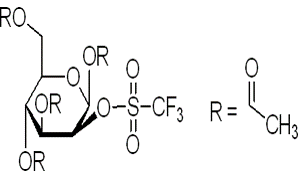
Mannose triflate(CAS# 92051-23-5)
| Hazard Symbols | Xi - Irritant |
| Safety Description | 24/25 - Avoid contact with skin and eyes. |
| WGK Germany | 3 |
| FLUKA BRAND F CODES | 10-21 |
| HS Code | 29329990 |
Introduction
Trifluoromannose. The following is an introduction to the properties, uses, preparation methods and safety information of trifluoromannose:
Quality:
- Appearance: Trifluoromannose is a colorless crystalline solid, which can be in the form of clumps or powders.
- Solubility: Trifluoromannose is almost insoluble in water, but it is soluble in organic solvents such as alcohols, ketones, and esters.
- Stability: Trifluoromannose has good thermal stability and can be stored for a long time under suitable conditions.
Use:
Method:
Trifluoromannose is usually prepared by hydrofluoric acid-catalyzed hydrohydrogenation. The specific step is to react trifluoroetophenone with hydrofluoric acid in the presence of a catalyst to generate trifluoromannose.
Safety Information:
- Trifluoromannose is considered safe in the human body. According to several studies, it is not carcinogenic, mutagenic, and teratogenic.
- Excessive intake of trifluoromannose may cause gastrointestinal problems such as diarrhea and gastrointestinal upset, especially in people who are sensitive to it.
- When using trifluoromannose, the appropriate dosage and precautions should be followed to avoid excessive intake.
Application
Mannose triflate (1,3,4,6-tetra-O-acetyl-2-O-trifluoromethanesulfonyl-β-D-mannopyranose, TATM) is a critical glucose analog and a highly reactive glycosyl donor. As a well-known precursor for the synthesis of 2-deoxy-2-[18F]fluoro-D-glucose ([18F]FDG), it is an indispensable building block for positron emission tomography (PET) imaging, enabling the non-invasive detection of cancer and other metabolic disorders. The binding of the radioactive 18F isotope occurs via an SN2 nucleophilic substitution reaction, achieving a fluorination yield of approximately 82%—a significant improvement over alternative precursors.
Beyond its role in radiopharmaceutical production, Mannose triflate is a highly effective glycosylating agent in complex carbohydrate synthesis. It enables the challenging and stereoselective formation of β-mannosidic linkages, a structural motif that is difficult to access using conventional methods like mannosyl bromides or thioglycosides. This unique reactivity, driven by its anomeric triflate leaving group, facilitates the synthesis of N-glycan cores and other complex oligosaccharides. Furthermore, it serves as a reactant in the synthesis of radioiodine-labeled quantum dots for use as fluorescent nano-probes in cell imaging studies. Xinchem offers high-purity Mannose triflate with comprehensive analytical characterization (NMR, HPLC) and flexible custom synthesis and contract manufacturing to support your demanding PET tracer production and glycosylation research. Contact us for a competitive quote and reliable global supply.