
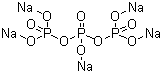
Sodium tripolyphosphate(CAS#7758-29-4)
| Hazard Symbols | Xi - Irritant |
| Risk Codes | 36/37/38 - Irritating to eyes, respiratory system and skin. |
| Safety Description | S26 - In case of contact with eyes, rinse immediately with plenty of water and seek medical advice. S36 - Wear suitable protective clothing. S24/25 - Avoid contact with skin and eyes. |
| WGK Germany | 1 |
| RTECS | YK4570000 |
| FLUKA BRAND F CODES | 3 |
| TSCA | Yes |
| HS Code | 28353110 |
| Toxicity | LD50 orally in rats: 6.50 g/kg (Smyth) |
Introduction
Sodium tripolyphosphate is a white crystalline powder. It is soluble in water but poorly soluble in organic solvents. Sodium tripolyphosphate has some important properties:Anti-scale performance: Sodium tripolyphosphate is an excellent scale inhibitor, with good complexation ability, can react with metal ions to prevent calcium and magnesium ions from scaling in hard water, thereby preventing pipelines and equipment from clogging.Emulsification and dispersion properties: Sodium tripolyphosphate has a strong emulsifying and dispersing effect, which can disperse grease and suspended solids in water, thereby enhancing the cleaning effect of detergents.Corrosion inhibition performance: Sodium tripolyphosphate can react with metal surfaces to form a protective sodium phosphate corrosion inhibition film to prevent metal corrosion.Sodium tripolyphosphate has a wide range of uses:Detergent: Used as an additive in detergents, laundry detergents, dish soaps and other detergents, it has the effect of enhancing the cleaning effect.Water treatment agent: used as a scale inhibitor and corrosion inhibitor, widely used in industrial water treatment, including boiler water treatment, cooling water treatment and other fields.Building materials industry: used as a cement additive, which can improve the fluidity of cement and delay the setting time.One common method of preparing sodium tripolyphosphate is to react phosphoric acid with sodium hydroxide to produce sodium tripolyphosphate crystals, which are then filtered, washed, and dried to obtain the final product.The following safety information should be noted when using it:Avoid direct contact with eyes and skin, and wear protective gloves and goggles when using it.Prevent dust inhalation and provide good ventilation conditions during operation.Contact with strong acids and combustibles is strictly prohibited to prevent violent reactions.Store in a dry, ventilated and dark place, away from fire and other chemicals.
Application
Sodium tripolyphosphate (STPP, CAS 7758-29-4) is a high-performance inorganic polyphosphate widely used as a water softener, sequestering agent, and suspending agent. In the detergent and cleaning industry, it is a key builder that chelates calcium and magnesium ions, prevents soil redeposition, and enhances surfactant efficiency in laundry powders, dishwashing tablets, and industrial cleaners. In food processing, STPP functions as a moisture retainer and texture improver for seafood, poultry, and meat products (e.g., shrimp and ham), as well as a stabilizer in dairy products and canned vegetables (E451). It also serves as a dispersing agent in ceramics, a deflocculant in drilling muds, and a corrosion inhibitor in water treatment. Additionally, STPP is used in leather tanning, paper manufacturing, and as a raw material for other phosphates. Xinchem offers custom synthesis, custom chemical synthesis, and contract manufacturing of high-purity sodium tripolyphosphate with flexible scaling from R&D to commercial tons. Contact us today for a competitive quote and reliable global supply.