
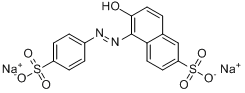
Sunset Yellow FCF (CAS#2783-94-0)
Sunset Yellow FCF, chemically designated as disodium 2-hydroxy-1-(4-sulfonatophenylazo)naphthalene-6-sulfonate, is a synthetic orange azo dye supplied as orange-red crystals, powder, or granules. It is odorless, freely soluble in water (up to 19 g/100 mL at 25 °C) and ethanol, but insoluble in oils and fats. The molecule contains two sulfonate groups that confer high aqueous solubility and a phenolic hydroxyl group that participates in the extended conjugated system responsible for its intense color. Its aqueous solution exhibits an absorption maximum at approximately 480–485 nm, producing the characteristic orange hue for which the dye is valued. Sunset Yellow FCF decomposes rather than melts at 390 °C, and the reported boiling point of 162.4 °C reflects a measured value that precedes thermal decomposition; the compound is not normally handled at or near these temperatures. It is stable under ordinary storage conditions but is combustible and incompatible with strong oxidizing agents. The log P near zero indicates negligible lipophilicity, consistent with its poor absorption through lipid membranes and its rapid excretion profile in biological systems.
Applications
Sunset Yellow FCF is a multipurpose synthetic colorant approved for use in food, pharmaceutical, and cosmetic applications, where it provides a stable orange to yellow-orange shade.
In food and beverages, it is one of the most widely used colorants globally, employed in soft drinks, confectionery, desserts, ice cream, sauces, and snack seasonings. The Codex General Standard for Food Additives (GSFA) includes provisions for Sunset Yellow FCF across a broad range of food categories, with maximum permitted levels typically ranging from 50 to 400 mg/kg depending on the product type. In the European Union, it is designated as E 110 and is subject to specification requirements for purity, including limits on subsidiary colouring matters (≤5.0%), the carcinogenic azo impurity Sudan I (≤0.5 mg/kg), unsulfonated primary aromatic amines (≤0.01% as aniline), and heavy metals including lead (≤2 mg/kg) and arsenic (≤3 mg/kg).
In pharmaceuticals, Sunset Yellow FCF (FD&C Yellow No. 6) is used as a colorant in tablets, capsules, syrups, and topical preparations, facilitating product identification and patient compliance. It is also employed in cosmetics and personal care products as a colorant in decorative cosmetics, shampoos, and cleaning products. The dye is additionally used in diagnostic and analytical applications, including as a color marker and in medical device staining.
Preparation Method
Sunset Yellow FCF is manufactured by a classical two-step diazotization–azo coupling sequence, a fundamental transformation in synthetic dye chemistry.
In the first step, 4-aminobenzenesulfonic acid (sulfanilic acid) is diazotized using sodium nitrite and hydrochloric acid (or sulfuric acid) at low temperature to form the diazonium salt. The reaction is conducted under acidic conditions with ice cooling to maintain the diazonium intermediate at a temperature where it is sufficiently stable for the subsequent coupling step.
In the second step, the diazonium salt is coupled with 6-hydroxynaphthalene-2-sulfonic acid (Schaeffer's acid) under alkaline conditions. The electron-rich naphthol ring undergoes electrophilic aromatic substitution at the position ortho to the hydroxyl group, forming the azo linkage that connects the two aromatic systems and generates the extended chromophore responsible for the dye's intense orange color. The product is isolated as the disodium salt, typically by salting out with sodium chloride, filtration, and drying. Commercial material may contain sodium chloride and/or sodium sulfate as the principal uncolored components, and the assay is specified as not less than 85% total colouring matters calculated as the sodium salt.
Safety Information
Sunset Yellow FCF carries a GHS Warning classification. The harmonized hazard statements commonly reported are H302 (Harmful if swallowed), H312 (Harmful in contact with skin), H315 (Causes skin irritation), H319 (Causes serious eye irritation), H332 (Harmful if inhaled), and H335 (May cause respiratory irritation). The substance is not classified as corrosive or acutely toxic at Category 1–3 levels, but the cumulative irritation and organ-specific hazards warrant standard industrial hygiene controls.
The acceptable daily intake (ADI) established by the FAO/WHO Joint Expert Committee on Food Additives (JECFA) is 0–2.5 mg/kg body weight per day for Sunset Yellow FCF, a value assigned in 1982 and retained in subsequent evaluations. The International Agency for Research on Cancer (IARC) has classified Sunset Yellow FCF in Group 3 (not classifiable as to its carcinogenicity to humans) . EFSA has also conducted a scientific opinion on the substance, providing maximum permitted levels according to EU food additive directives.
For safe handling, avoid generating and inhaling dust, and use local exhaust ventilation where powder handling occurs. Personal protective equipment should include safety glasses or goggles, protective gloves, and protective clothing appropriate to the handling scale. In case of eye contact, rinse cautiously with water for several minutes, remove contact lenses if present and easy to do so, and continue rinsing; if eye irritation persists, seek medical advice (P305+P351+P338, P337+P313). For skin contact, wash with plenty of soap and water (P302+P352); if skin irritation occurs, seek medical attention (P332+P313). If swallowed and feeling unwell, contact a poison center or physician (P301+P312). If inhaled and symptoms occur, move the victim to fresh air and keep at rest in a position comfortable for breathing (P304+P340). Store in a tightly closed container in a cool, dry place protected from light and moisture. Spills should be swept up or vacuumed with dust suppression and disposed of in accordance with local regulations; release to drains and watercourses should be avoided.