
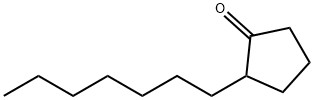
2-n-Heptylcyclopentanone(CAS#137-03-1)
| Risk Codes | 36/37/38 – Irritating to eyes, respiratory system and skin. |
| Safety Description | S26 – In case of contact with eyes, rinse immediately with plenty of water and seek medical advice. S37 – Wear suitable gloves. |
| RTECS | GY4950000 |
| TSCA | Yes |
| Toxicity | The acute oral LD50 value in rats was reported as > 5 g/kg (Shelanski, 1973). The acute dermal LD50 value in rabbits was reported as 5 g/kg (Shelanski, 1973). |
Introduction
2-n-heptylcyclopentanone is an organic compound. The following is an introduction to its nature, use, preparation method and safety information:
Quality:
- Appearance: 2-n-heptylcyclopentanone is generally a colorless liquid with a special aroma.
- Solubility: 2-n-heptylcyclopentanone is soluble in many organic solvents, such as alcohols, ethers, and alkanes.
Use:
- Chemical synthesis: 2-n-heptylcyclopentanone can be used as a starting substance for the synthesis of other organic compounds in organic synthesis reactions.
Method:
The preparation of 2-n-heptylcyclopentanone is generally completed by the following steps:
Reaction: n-heptanol reacts with cyclopentanone to form 2-n-heptylcyclopentanone.
Separation: The resulting 2-n-heptylcyclopentanone is purified by distillation or other separation techniques.
Safety Information:
-2-n-heptylcyclopentanone is generally safe for routine use, but caution is still required.
- Like other organic compounds, it is flammable and should be kept away from open flames and high temperatures.
- During use, take precautions such as wearing gloves and goggles, and ensure good ventilation.
- During storage and disposal, follow relevant safety operating procedures and dispose of waste properly.