
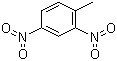
2,4-Dinitrotoluene(CAS#121-14-2)
| Risk Codes | R45 - May cause cancer R23/24/25 - Toxic by inhalation, in contact with skin and if swallowed. R48/22 - Harmful danger of serious damage to health by prolonged exposure if swallowed. R51/53 - Toxic to aquatic organisms, may cause long-term adverse effects in the aquatic environment. R62 - Possible risk of impaired fertility R68 - Possible risk of irreversible effects R39/23/24/25 - R11 - Highly Flammable R52/53 - Harmful to aquatic organisms, may cause long-term adverse effects in the aquatic environment. R36 - Irritating to the eyes R20/21/22 - Harmful by inhalation, in contact with skin and if swallowed. R50/53 - Very toxic to aquatic organisms, may cause long-term adverse effects in the aquatic environment. |
| Safety Description | S53 - Avoid exposure - obtain special instructions before use. S45 - In case of accident or if you feel unwell, seek medical advice immediately (show the label whenever possible.) S61 - Avoid release to the environment. Refer to special instructions / safety data sheets. S36/37 - Wear suitable protective clothing and gloves. S16 - Keep away from sources of ignition. S26 - In case of contact with eyes, rinse immediately with plenty of water and seek medical advice. S60 - This material and its container must be disposed of as hazardous waste. |
| UN IDs | UN 3454 6.1/PG 2 |
| WGK Germany | 3 |
| RTECS | XT1575000 |
| TSCA | Yes |
| HS Code | 29042030 |
| Hazard Class | 6.1 |
| Packing Group | II |
| Toxicity | Acute oral LD50 for mice 790 mg/kg, rats 268 mg/kg, guinea pigs 1.30 g/kg (quoted, RTECS, 1985). |
2,4 Dinitrotoluene 2,4 DNT | CAS 121 14 2
One Line Sourcing Position
High purity 2,4 Dinitrotoluene for polyurethane intermediates, dye manufacturing, and explosive production applications.
Quick RFQ Form
Fill below to get instant quote:
Name Email Company Required quantity Delivery destination Submit
Specification
Purity by GC: 99.0 percent minimum, typical batch 99.2 to 99.5 percent
Appearance: White to orange to green powder to crystal
Molecular formula: C7H6N2O4
Molecular weight: 182.14 g per mol
Melting point: 70.0 to 73.0 degrees Celsius
Boiling point: 300 degrees Celsius (decomposes)
Density: 1.52 g per cubic centimeter (relative to water)
Refractive index: 1.442 at 20 degrees Celsius
Water solubility: 0.3 g per L at 22 degrees Celsius, practically insoluble
Vapor pressure: 0.02 Pa at 25 degrees Celsius
Flash point: 169 degrees Celsius (closed cup)
Residue on ignition: 0.05 percent maximum
Heavy metals: Less than 10 ppm
Stock Status: In Stock in US warehouse and China hub
Available Quantity and Lead Time
Regular supply: 500 g to 25 metric tons per shipment
Lead time: 3 to 5 days for standard packaging; bulk orders require 7 to 10 days
Document Support
COA SDS HPLC chromatogram NMR spectrum Mass spectrum MS available upon request
Application
2,4 Dinitrotoluene is a versatile nitroaromatic compound serving as a critical intermediate across multiple industrial sectors. In the polyurethane industry, it is hydrogenated to produce toluene diamine (TDA), which is subsequently converted to toluene diisocyanate (TDI), the essential raw material for flexible polyurethane foams used in bedding, furniture, and automotive applications. The compound is also a key precursor in the manufacture of trinitrotoluene (TNT) explosives, munitions, and propellants. In the dye and pigment industry, 2,4 dinitrotoluene derivatives are used to produce sulfur dyes including Sulfur Yellow GC, Sulfur Yellow Brown 5G, Sulfur Yellow Brown 6G, and Sulfur Red Brown B3R. It also serves as an intermediate for rubber chemicals, plastics, and other organic synthesis applications. In analytical chemistry, 2,4 dinitrotoluene is used as an analytical standard for the determination of nitroaromatic compounds in forensic samples, explosive contaminated groundwater, industrial effluents, and seawater by various chromatographic techniques.
Custom Synthesis Support
We offer custom synthesis for 2,4 dinitrotoluene derivatives including isotopically labeled analogs, higher purity grades (99.5 percent and above), and custom isomer compositions. Our specialized nitration facilities support development and production from laboratory scale to commercial quantities. Share your technical datasheet for feasibility review.
Packaging and Shipping
Available in 500 g, 1 kg, 5 kg, 25 kg fiber drums with polyethylene inner liner, or 200 kg steel drums. Custom packaging such as double sealed aluminum foil bags under nitrogen is supported. Fastest dispatch within 7 days after order confirmation.
Important shipping information: 2,4 Dinitrotoluene is a hazardous material classified as Class 6.1 toxic substance, UN 3454, Packaging Group II. Store in a cool, dry, well ventilated area away from ignition sources, oxidizing agents, reducing agents, and strong bases. Keep container tightly sealed. The substance is combustible and may explode on heating. Microfine particles dispersed in air may form explosive mixtures. Friction, shock, or impact may cause combustion or explosion. Store in a fireproof location, away from food and feed.
Why XinChem
XinChem provides 2,4 dinitrotoluene with strict control of purity and impurity profile for US customers. Our ISO 9001 certified facility monitors every batch by GC and melting point analysis, ensuring consistent quality for polyurethane intermediate and specialty chemical applications. We maintain a buffer stock in US warehouses for emergency deliveries within 48 hours. Each order includes a full documentation package: COA, SDS, and chromatograms accessible through our online portal. Our technical support team assists with handling precautions, stability under storage, and regulatory compliance including TSCA (Yes), EINECS (204-450-0), and international shipping regulations. For contract customers, we offer quarterly price locks and consignment inventory to reduce supply chain risk. Trusted by numerous polyurethane, dye, and specialty chemical companies in North America. We also provide free sample evaluation for qualified R&D projects and a price match guarantee against any valid competitor quote for equivalent quality. All shipments include clear handling instructions and appropriate hazard communication to ensure safety throughout the supply chain.
FAQ
Q1 How should 2,4 dinitrotoluene be stored safely?
A Store in a cool, dry, well ventilated area away from ignition sources, oxidizing agents, reducing agents, and strong bases. Keep container tightly sealed. Store in a fireproof location, away from food and feed. Shelf life is 24 months under recommended conditions.
Q2 What purity grades do you supply?
A Standard grade is 99.0 percent minimum by GC. We also supply 99.5 percent grade for pharmaceutical and analytical reference applications.
Q3 Is 2,4 dinitrotoluene soluble in water?
A It is practically insoluble in water (0.3 g per L at 22 degrees Celsius). It is soluble in organic solvents such as ethanol, methanol, ether, acetone, benzene, and methylene chloride.
Q4 Do you provide sample quantities for method development?
A Yes, free samples of 100 g are available for qualified US companies. Shipping fee applies for small quantities due to hazardous material classification.
Q5 What safety precautions are required when handling 2,4 dinitrotoluene?
A 2,4 Dinitrotoluene is toxic and a suspected carcinogen (IARC Group 2B). Use in a fume hood with full PPE including chemical resistant gloves, safety goggles, and protective clothing. Avoid inhalation of dust and skin contact. The substance may cause methemoglobin formation. Keep away from heat, sparks, and open flames. In case of contact, rinse immediately with plenty of water and seek medical attention.
Q6 What are the main applications of 2,4 dinitrotoluene?
A The primary applications include: (1) hydrogenation to toluene diamine for TDI production in polyurethane foams; (2) precursor for TNT explosives and munitions; (3) intermediate for sulfur dyes and pigments; (4) raw material for rubber chemicals and plastics; and (5) analytical standard for chromatographic determination of nitroaromatic compounds.
Q7 Is 2,4 dinitrotoluene regulated as a hazardous substance?
A Yes. It is listed as a Substance of Very High Concern (SVHC) under REACH due to its carcinogenicity (Category 2). It is also included in the List of Explosive Precursor Chemicals and subject to strict control under the Easy Explosive Hazardous Chemicals Control Regulations. UN Number 3454, Class 6.1, Packing Group II.