
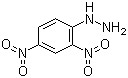
2,4-Dinitrophenylhydrazine(CAS#119-26-6)
| Hazard Symbols | F - FlammableXn - Harmful |
| Risk Codes | R1 - Explosive when dry R11 - Highly Flammable R22 - Harmful if swallowed R40 - Limited evidence of a carcinogenic effect |
| Safety Description | S16 - Keep away from sources of ignition. S36/37 - Wear suitable protective clothing and gloves. S45 - In case of accident or if you feel unwell, seek medical advice immediately (show the label whenever possible.) |
| UN IDs | UN 3380 |
2,4-Dinitrophenylhydrazine(CAS#119-26-6) introduce
quality
Trusted data
Red crystalline powder. The melting point is about 200°C. Slightly soluble in water, ethanol, soluble in acid. Explosion can occur when exposed to heat, contact with open flame, high heat, friction, vibration, and impact. When burned, it emits toxic and irritating fumes. Mixing with oxidants can form explosive mixtures.
Method
Trusted data
Hydrazine sulfate was suspended in hot water, potassium acetate was added, cooled after boiling, ethanol was added, solids were filtered out, and the filtrate was washed with ethanol. 2,4-= nitrophenyl ethanol was added to the above hydrazine solution, and 2,4-= nitrophenylhydrazine was obtained by filtration, washing, drying, and filtrate concentration.
use
Trusted data
It is a chromogenic reagent for the determination of aldehydes and ketones by thin layer chromatography. It is used as an ultraviolet derivatization reagent for aldehydes and ketones in organic synthesis and explosives manufacturing.
security
Trusted data
rat oral LDso: 654mg/kg. It is irritating to the eyes and skin. It is sensitizing to the skin. This product is absorbed into the body, which can cause methemoglobinemia and cyanosis. Store in a cool, ventilated warehouse. Keep away from fire and heat sources. The warehouse temperature should not exceed 30°C. Protect from direct sunlight. Keep the container tightly sealed. For safety reasons, it is often wetted and passivated with no less than 25% water during storage and transportation. It should be stored separately from oxidants and acids. Do not mix storage and transportation.
2,4 Dinitrophenylhydrazine DNPH Brady reagent | CAS 119 26 6
One Line Sourcing Position
High purity 2,4 Dinitrophenylhydrazine for carbonyl compound analysis, HPLC derivatization, and organic synthesis applications.
Quick RFQ Form
Fill below to get instant quote:
Name Email Company Required quantity Delivery destination Submit
Specification
Purity: 98.0 percent minimum by GC, typical batch 98.5 to 99.0 percent
Appearance: Red to orange red crystalline powder
Molecular formula: C6H6N4O4
Molecular weight: 198.14 g per mol
Melting point: 197 to 202 degrees Celsius with decomposition
Moisture content: 0.5 percent maximum
Residue on ignition: 0.1 percent maximum
Solubility: Slightly soluble in water and alcohol; soluble in dilute inorganic acids, hot ethanol, ethyl acetate, and aniline; readily soluble in diglyme
Sulfuric acid dissolution test: Pass
Carbonyl sensitivity test: Pass
Stock Status: In Stock in US warehouse and China hub
Available Quantity and Lead Time
Regular supply: 25 g to 5 metric tons per shipment
Lead time: 3 to 5 days for standard packaging; bulk orders require 7 to 10 days
Document Support
COA SDS HPLC chromatogram NMR spectrum Mass spectrum MS available upon request
Application
2,4 Dinitrophenylhydrazine (DNPH) is a substituted hydrazine reagent widely recognized as a foundational tool in analytical chemistry. Known as Brady reagent, it is most famously used for the qualitative and quantitative detection of carbonyl compounds aldehydes and ketones. The reagent reacts with carbonyl groups to form brightly colored hydrazone derivatives, which can be isolated, characterized, and used as evidence toward the identity of the original compound.
In HPLC and LC MS analysis, DNPH serves as a critical derivatization agent for the determination of aldehydes and ketones in environmental, pharmaceutical, and biochemical samples. It is the basic reagent specified in several international standard procedures for carbonyl compound analysis. Common applications include the determination of formaldehyde content in daily products and indoor air quality monitoring. In clinical biochemistry, it is used to measure transaminase and liver function.
Beyond analytical chemistry, DNPH is an important organic synthesis intermediate. It serves as a raw material for the synthesis of phenylhydrazone compounds, Schiff base derivatives, and various nitrogen containing heterocycles. In materials science, DNPH has been investigated as a potent corrosion inhibitor for carbon steel in acidic environments. It also finds applications in dye manufacturing and explosive production.
Custom Synthesis Support
We offer custom synthesis for 2,4 dinitrophenylhydrazine derivatives including hydrazone derivatives, substituted phenylhydrazines, and isotopically labeled analogs. Our specialized nitration facilities support development and production from hundred kilogram to hundred metric ton scale. Share your technical datasheet for feasibility review.
Packaging and Shipping
Available in 25 g, 100 g, 500 g, 1 kg, or 25 kg fiber drums with polyethylene inner liner. DNPH is typically supplied wet with 30 to 50 percent water as a desensitizing agent to reduce explosive hazard. Custom packaging such as double sealed aluminum foil bags under nitrogen is supported. Fastest dispatch within 7 days after order confirmation.
Important shipping information: DNPH is classified as a flammable solid Class 4.1, UN 3380, Packaging Group I. Store in a cool, dry, well ventilated area away from oxidizing agents. Keep wetted with water. Protect from light and store at 2 to 8 degrees Celsius in a flammable materials area. Dry material is sensitive to shock and friction and may explode.
Why XinChem
XinChem provides 2,4 dinitrophenylhydrazine with strict control of purity, moisture content, and carbonyl sensitivity for US customers. Our ISO 9001 certified facility monitors every batch by HPLC and melting point analysis, ensuring consistent quality for analytical and synthesis applications. We maintain a buffer stock in US warehouses for emergency deliveries within 48 hours. Each order includes a full documentation package: COA, SDS, and chromatograms accessible through our online portal. Our technical support team assists with handling precautions, stability under storage, and regulatory compliance including TSCA and EINECS. For contract customers, we offer quarterly price locks and consignment inventory to reduce supply chain risk. Trusted by numerous analytical laboratories, pharmaceutical companies, and research institutions in North America. We also provide free sample evaluation for qualified R&D projects and a price match guarantee against any valid competitor quote for equivalent quality. All shipments are packaged wet with water as a desensitizing agent and include clear handling instructions to ensure safety.
FAQ
Q1 Why is 2,4 dinitrophenylhydrazine supplied wet with water?
A Dry DNPH is sensitive to shock and friction and can explode. It is supplied wet with approximately 30 to 50 percent water as a desensitizing agent to reduce its explosive hazard. Never allow the material to dry out completely during storage.
Q2 What purity grades do you supply?
A Standard grade is 98.0 percent minimum by GC. We also supply 99.0 percent AR grade for analytical applications and 97 percent reagent grade. Higher purity grades are available upon request.
Q3 Is 2,4 dinitrophenylhydrazine soluble in water?
A It is slightly soluble in water. It is soluble in dilute inorganic acids, hot ethanol, ethyl acetate, and aniline, and readily soluble in diglyme (diethylene glycol dimethyl ether).
Q4 Do you provide sample quantities for method development?
A Yes, free samples of 25 g are available for qualified US companies. Shipping fee applies for small quantities due to hazardous material classification.
Q5 What safety precautions are required when handling DNPH?
A DNPH is flammable and harmful if swallowed. It may cause eye and skin irritation and has potential skin sensitizing effects. Use in a fume hood with full PPE including chemical resistant gloves, safety goggles, and lab coat. Keep away from heat, sparks, and open flames. Avoid friction and impact with dry material. In case of contact, rinse immediately with plenty of water.
Q6 What are the common applications of DNPH in analytical chemistry?
A DNPH is used as a derivatization reagent for the analysis of aldehydes and ketones by HPLC and LC MS. It is the standard reagent for several international protocols for carbonyl compound determination and is commonly used for formaldehyde detection in indoor air and consumer products.