
page_banner

product

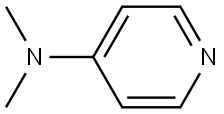
4-Dimethylaminopyridine(CAS#1122-58-3)

Chemical Property:

1122-58-3 – Names and Identifiers

Name 4-Dimethylaminopyridine
Synonyms DMAP
26DCLPY
AURORA KA-6495
AKOS BBS-00004314
4-dimethylamiopryidine
4dimethylaminopyridine
4-Dimethylaminopyridine
4-Dimethylaminepyridine
p-Dimethylaminopyridine
4 dimethylamino pyridine
4-dimethylamino pyridine
4-(dimethylamino)-pyridin
4-(Dimethylamino)pyridine
4-Dimethyl amino pyridine
n,n-dimethyl-4-pyridinamin
N-(4-Pyridyl)dimethylamine
N,N-dimethylpyridin-4-amine
N,N-Dimethyl-4-pyridinamine
4-N,N-Dimethylaminopyridine
N,N-dimethylpyridin-2-amine
Dimethyl-pyridin-4-yl-amine
4-(dimethylamino)pyridinium
Pyridine, 4-(dimethylamino)-
N,N’-DIMEHTYL-4-PYRIDINAMINE
N,N-Dimethyl-4-aminopyridine
gamma-(Dimethylamino)pyridine
Dimethyl-pyridin-4-yl-amine(DMAP)
4-(DIMETHYLAMINO)PYRIDINE SOLUTION
4-(Dimethylamino)PyridineForSynthesis
4-(Dimethylamino) PyridineForSynthesis
4-(Dimethylamino)pyridine, ReagentPlus
CAS 1122-58-3
EINECS 214-353-5
InChI InChI=1/C7H10N2/c1-9(2)7-3-5-8-6-4-7/h3-6H,1-2H3/p+1

1122-58-3 – Physico-chemical Properties

Molecular Formula C7H10N2
Molar Mass 122.17
Density 0.906 g/mL at 25 °C
Melting Point 112 °C
Boling Point 162 °C
Flash Point 110 °C
Water Solubility 76 g/L (25 ºC)
Solubility Soluble in water, ethanol, acetone, benzene, toluene, xylene, dichloroethane, chloroform, acetic acid, acetic anhydride, ethyl acetate, hexane, tetrahydrofuran, triethylamine, pyridine, DMF and other solvents.
Vapor Presure 0.169 hPa at 20 °C
Appearance White crystal
Color off-white to yellow
Odor characteristic odor
Merck 14,3389
BRN 110354
pKa pKa (20°): 9.7
PH 11 (60g/l, H2O, 20℃)
Storage Condition Store below +30°C.
Stability Stable. Incompatible with acids, oxidizing agents.
Refractive Index n20/D 1.431
MDL MFCD00006418
Physical and Chemical Properties trait light yellow or white crystal
Use 4-dimethylaminopyridine is a new type of efficient catalyst widely used in chemical synthesis, in organic synthesis, drug synthesis, pesticides, dyes, spices and other synthetic acylation, alkylation, etherification and other types of reactions have high catalytic ability, and have an extremely obvious effect on improving the yield.

Product Detail

Product Tags

1122-58-3 – Risk and Safety

Risk Codes R25 – Toxic if swallowed
R34 – Causes burns
R24/25 -
R36/37/38 – Irritating to eyes, respiratory system and skin.
R27 – Very Toxic in contact with skin
R36 – Irritating to the eyes
R24 – Toxic in contact with skin
R20 – Harmful by inhalation
R61 – May cause harm to the unborn child
R40 – Limited evidence of a carcinogenic effect
R23/24/25 – Toxic by inhalation, in contact with skin and if swallowed.
R67 – Vapors may cause drowsiness and dizziness
R66 – Repeated exposure may cause skin dryness or cracking
R21/22 – Harmful in contact with skin and if swallowed.
R11 – Highly Flammable
R36/37 – Irritating to eyes and respiratory system.
R22 – Harmful if swallowed
R19 – May form explosive peroxides
Safety Description S36/37/39 – Wear suitable protective clothing, gloves and eye/face protection.
S45 – In case of accident or if you feel unwell, seek medical advice immediately (show the label whenever possible.)
S28A -
S26 – In case of contact with eyes, rinse immediately with plenty of water and seek medical advice.
S28 – After contact with skin, wash immediately with plenty of soap-suds.
S36/37 – Wear suitable protective clothing and gloves.
S53 – Avoid exposure – obtain special instructions before use.
S27 – Take off immediately all contaminated clothing.
S22 – Do not breathe dust.
S16 – Keep away from sources of ignition.
UN IDs UN 2811 6.1/PG 2
WGK Germany 3
RTECS US8400000
TSCA T
HS Code 29333999
Hazard Note Toxic/Corrosive
Hazard Class 8
Packing Group II
Toxicity LD50 orally in Rabbit: 140 mg/kg LD50 dermal Rabbit 90 mg/kg

  • Previous:
  • Next:

  • Write your message here and send it to us