
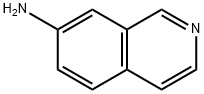
7-Aminoisoquinoline(CAS#23707-37-1)
| Safety Description | 24/25 - Avoid contact with skin and eyes. |
| HS Code | 29334900 |
Introduction
7-Aminoisoquinoline is an organic compound. The following is an introduction to the properties, uses, preparation methods and safety information of 7-aminoisoquinoline:Quality:- 7-Aminoisoquinoline is a solid crystal in the form of a white to light yellow crystalline powder.- It is stable at room temperature, but it oxidizes easily at high temperatures and light.- 7-Aminoisoquinoline is weakly basic in solution.Use:- 7-Aminoisoquinoline is a useful chemical intermediate that is widely used in organic synthesis reactions.Method:- 7-Aminoisoquinoline is usually obtained by the thermal reaction of benzylamine and citric acid or citric anhydride under certain conditions.- The specific preparation method can be optimized according to the actual needs.Safety Information:- 7-Aminoisoquinoline is generally relatively safe for humans and the environment.- As a chemical, appropriate safety measures should be taken. When touching, skin, eye, and respiratory contact should be avoided.- Care should be taken to follow laboratory or plant safety handling guidelines and proper disposal of chemical waste when using or handling 7-aminoisoquinoline.
Application
7-Aminoisoquinoline (isoquinolin-7-amine, CAS 23707-37-1) is a functionalized heterocyclic building block belonging to the isoquinoline alkaloid class. It serves as a crucial intermediate in medicinal chemistry and drug discovery. The compound exhibits significant biological activities, including interaction with cyclin-dependent kinase 1 (CDK1) and the cyclin B1 complex, leading to mitotic arrest and apoptotic cell death in cancer cells, making it valuable for developing novel anticancer therapeutics. Patents describe its use as a kinase inhibitor to treat cancer, obesity, and glaucoma. Additionally, it functions as a photosensitizer in photodynamic therapy (PDT) and as a fluorescent probe for bioimaging. The primary amine enables amide, urea, and sulfonamide formation, while the isoquinoline core allows cross-coupling reactions (Suzuki-Miyaura, Buchwald-Hartwig) for rapid diversification. It is also employed in synthesizing VEGFR inhibitors, anti-HIV agents, and antimicrobial compounds. Its high purity (>98%) ensures reproducible results in high-throughput screening, SAR studies, and scalable GMP synthesis. All products are for R&D use only. Xinchem offers custom synthesis, custom chemical synthesis, and contract manufacturing of high-purity 7-Aminoisoquinoline with flexible scaling from R&D to commercial tons. Contact us today for a competitive quote and reliable global supply.