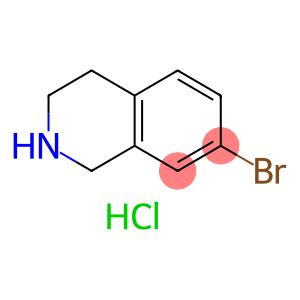
7-Bromo-1,2,3,4-tetrahydroisoquinoline hydrochloride(CAS#220247-73-4)
Introduction
7-Bromo-1,2,3,4-tetrahydroisoquinoline hydrochloride. The following is an introduction to its nature, use, preparation method and safety information:Quality:Appearance: white or off-white crystal powder.Solubility: soluble in ethanol, chloroform and dimethylformamide, slightly soluble in water.Storage conditions: It should be stored in a dry place away from light.Use:Method:The preparation of 7-bromo-1,2,3,4-tetrahydroisoquinoline hydrochloride is generally carried out by the following steps:Under alkaline conditions, 4-acetaminobenzene and benzaldehyde are condensed to generate 4-formamino-α, β-unsaturated ketone.The ketone compound was reacted with 3-bromo-1-propene to generate 7-bromo-1,2,3,4-tetrahydroisoquinoline.The resulting 7-bromo-1,2,3,4-tetrahydroisoquinoline is reacted with hydrochloric acid to form 7-bromo-1,2,3,4-tetrahydroisoquinoline hydrochloride.Safety Information:7-Bromo-1,2,3,4-tetrahydroisoquinoline hydrochloride should be used in a well-ventilated environment to avoid inhalation or contact with skin and eyes.Appropriate protective gloves, protective glasses and protective masks should be worn during use.In case of accidental contact with skin or eyes, rinse immediately with plenty of water and seek medical attention promptly.The compound belongs to organic halides, which have certain toxicity and should be handled safely.
Application
7-Bromo-1,2,3,4-tetrahydroisoquinoline hydrochloride (CAS 220247-73-4) is a privileged brominated tetrahydroisoquinoline (THIQ) scaffold widely utilized as a versatile building block in medicinal chemistry and pharmaceutical research. This advanced heterocyclic intermediate is essential for the synthesis of diverse bioactive molecules targeting the central nervous system (CNS), including potential therapeutics for neurodegenerative diseases (Parkinson's, Alzheimer's), psychiatric disorders (depression, anxiety), and various cancers. The reactive bromine at the 7-position enables efficient cross-coupling reactions (Suzuki-Miyaura, Buchwald-Hartwig) and nucleophilic substitutions, allowing rapid structural diversification for structure-activity relationship (SAR) studies. This compound serves as a key precursor for developing selective kinase inhibitors, GPCR modulators, and neuroprotective agents. Its unique reactivity and drug-like properties also make it valuable in agrochemical research and the synthesis of complex organic molecules. Xinchem offers custom synthesis, custom chemical synthesis, and contract manufacturing of high-purity this compound with flexible scaling from R&D to commercial tons. Contact us today for a competitive quote and reliable global supply.