

Cyclohexyl(dimethoxy)methylsilane (CAS#17865-32-6)
Cyclohexyl(dimethoxy)methylsilane (CHMMS), also known by the trade designation Donor-C, is an organosilicon compound featuring a cyclohexyl group, a methyl group, and two methoxy groups bonded to a central silicon atom. It is supplied as a colorless, transparent, low-viscosity liquid with a mild odor, a boiling point of 196–201 °C, a flash point of 66 °C (closed cup), and a density of approximately 0.94–0.947 g/mL at 25 °C. The compound is moisture-sensitive and hydrolyzes slowly in the presence of water, a reactivity that is central to its function as a silane coupling agent and surface modifier. It is stable under inert atmosphere and is recommended for storage in a cool, dark place at temperatures below 15 °C to maintain product quality.
The molecular structure combines a bulky cyclohexyl substituent with two hydrolyzable methoxy groups and one non-hydrolyzable methyl group on silicon. This arrangement allows the molecule to anchor onto hydroxyl-bearing surfaces through Si–O–M bond formation (where M is a substrate metal or silicon atom) while presenting a hydrophobic cyclohexyl terminus. The steric bulk of the cyclohexyl group also plays a decisive role in the compound's primary catalytic application, where it selectively coordinates to specific crystal faces of the catalyst support.
Applications
The dominant commercial application of Cyclohexyl(dimethoxy)methylsilane is as an external electron donor (EED) in MgCl₂-supported Ziegler-Natta catalysts for propylene polymerization. In this role, CHMMS is introduced together with the aluminum alkyl co-catalyst during polymerization, where it selectively coordinates to magnesium atoms on the (110) surface of the MgCl₂ support, blocking TiCl₄ from coordinating at random, non-stereospecific active sites. This selective poisoning of atactic sites dramatically enhances the isotacticity of the resulting polypropylene, typically pushing isotactic index values into the 95–99% range while maintaining high catalyst activity in the range of 15–35 kg PP/g Ti·h depending on catalyst generation. CHMMS demonstrates resilience under industrial polymerization conditions (≥70 °C), maintaining structural integrity without decomposing into siloxanes or silanols under inert atmosphere, which is critical for consistent polymer microstructure control in continuous production.
Beyond polyolefin catalysis, CHMMS functions as a silane coupling agent and surface modifier in coatings, adhesives, and sealant formulations, where its methoxy groups undergo hydrolysis-condensation with inorganic substrates to improve adhesion and water resistance at the interface. It is also employed as a structural control agent in silicone rubber processing, where it regulates crosslink density and improves the mechanical properties of vulcanized rubber. The compound serves as a precursor in the synthesis of silicone polymers and as an intermediate in organic synthesis.
Preparation Method
The primary synthetic route to Cyclohexyl(dimethoxy)methylsilane is the Grignard reaction of a cyclohexylmagnesium halide with methyltrimethoxysilane. Cyclohexyl chloride (or bromide) is reacted with magnesium turnings in an ethereal solvent to form the Grignard reagent, which is then added to an excess of methyltrimethoxysilane. The Grignard nucleophile displaces one methoxy group from silicon, installing the cyclohexyl substituent while leaving the methyl group and the remaining two methoxy groups intact. A solventless, one-step synthesis has been reported, and a representative process uses approximately 70 kg of methyltrimethoxysilane, 60 kg of chlorocyclohexane, 12 kg of magnesium powder, and 0.1 kg of potassium iodide as catalyst, achieving a yield of 90.1% with purity of ≥99% after distillation. The product is isolated and purified by distillation under reduced pressure.
Safety Information
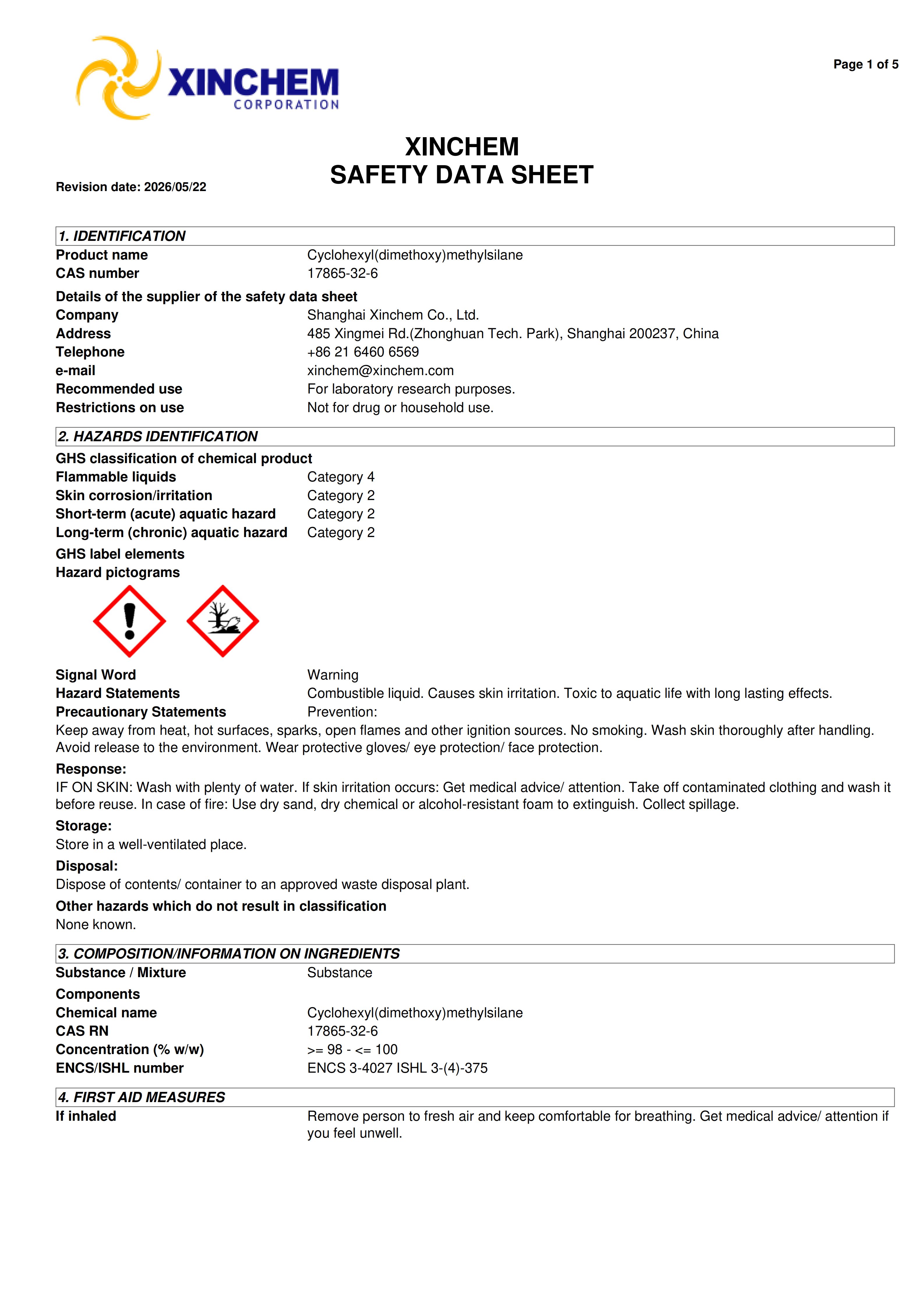
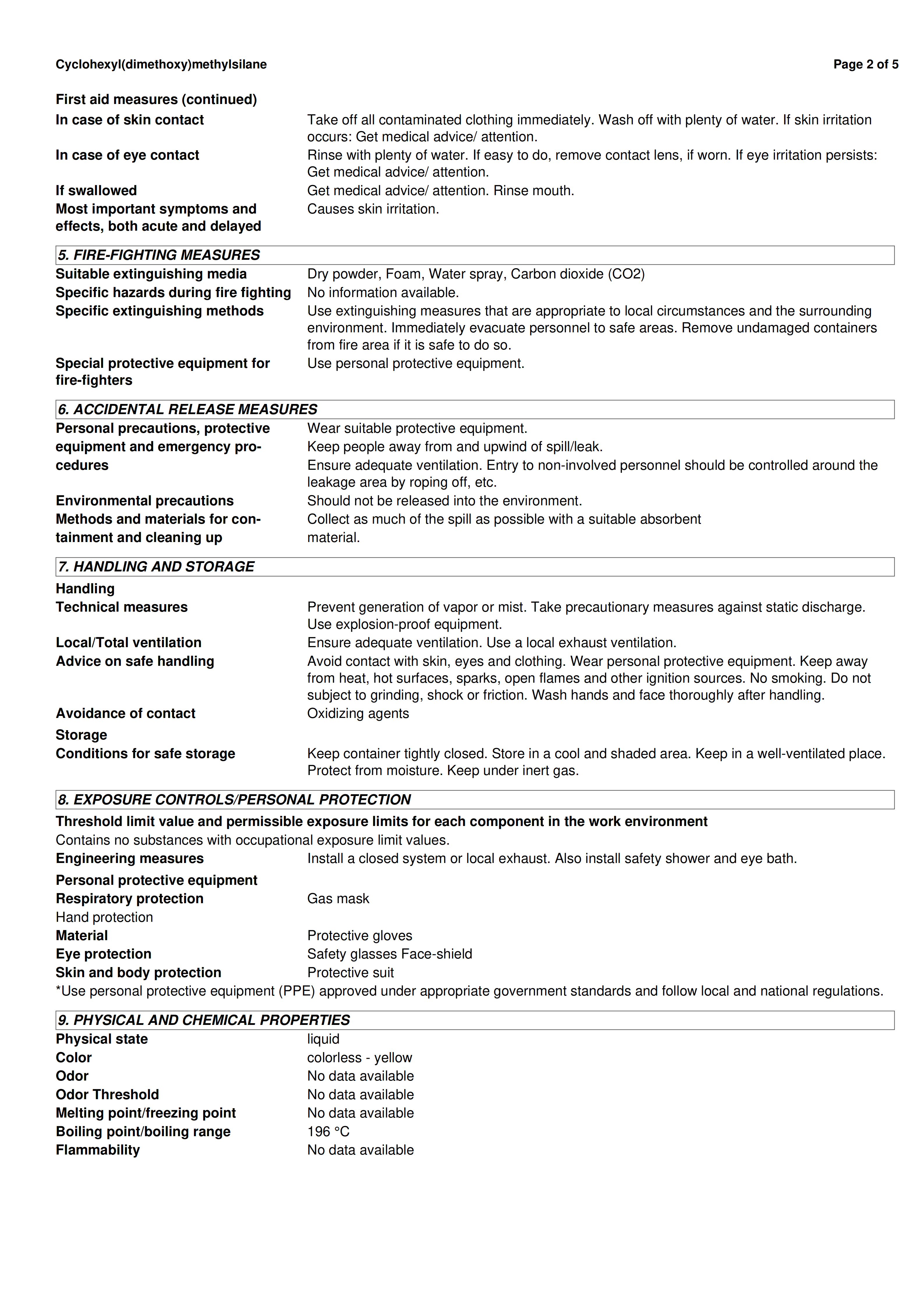
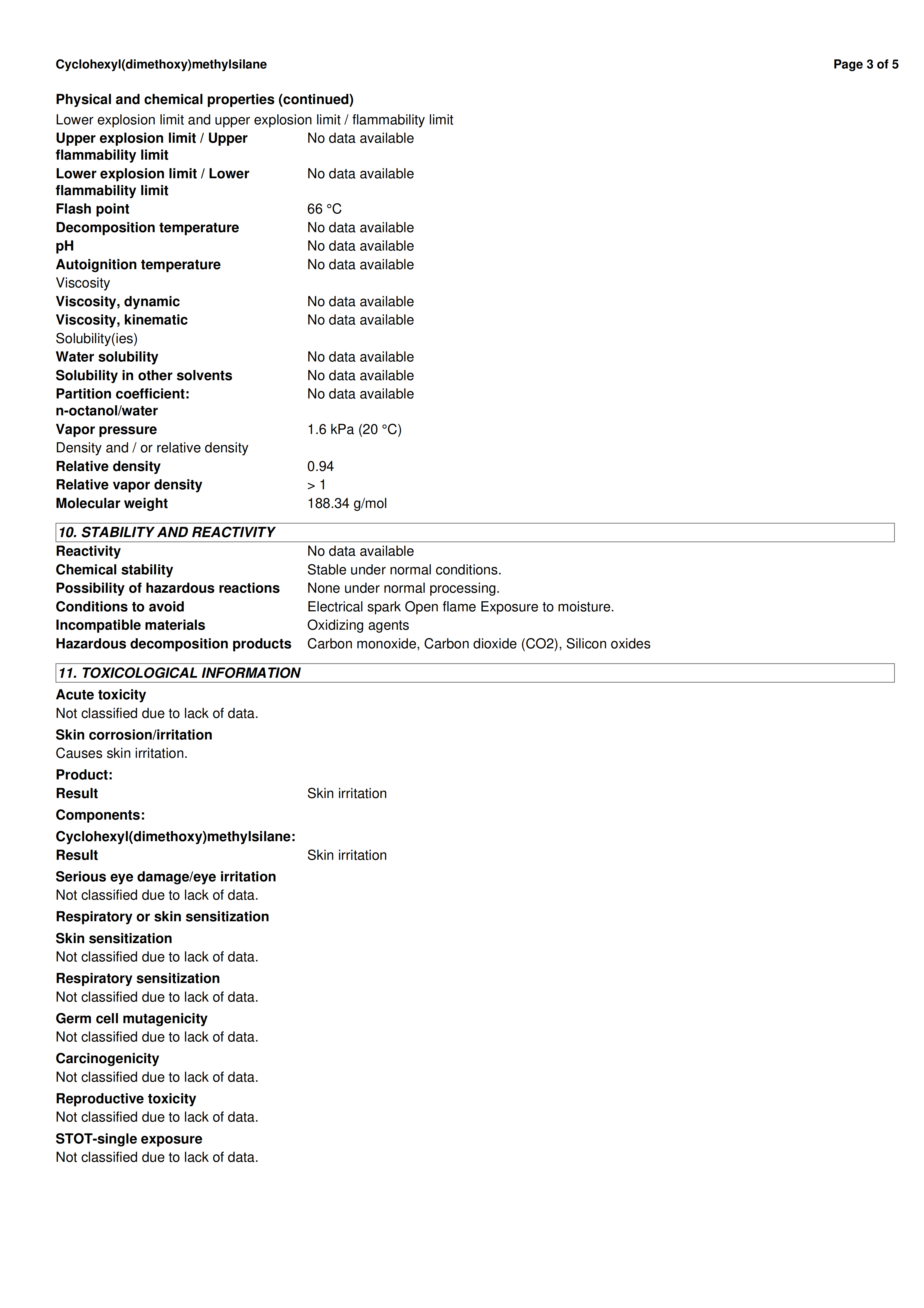
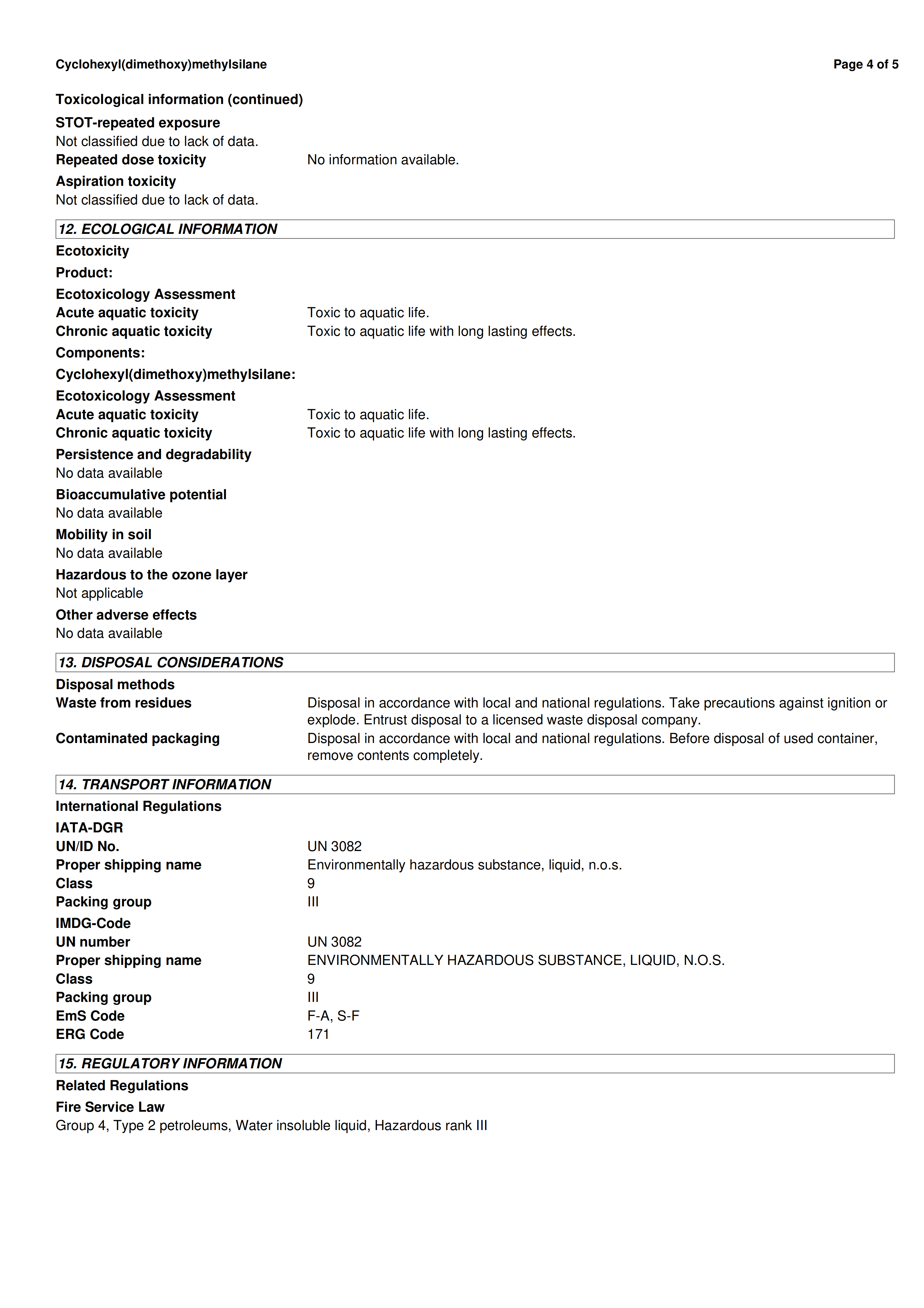
Cyclohexyl(dimethoxy)methylsilane is classified under GHS with the signal word Warning. The harmonized hazard statements include H227 (Combustible liquid), H315 (Causes skin irritation), and H411 (Toxic to aquatic life with long lasting effects) . It is assigned to Flammable Liquids Category 4, Skin Irritation Category 2, and Chronic Aquatic Toxicity Category 2 . The substance is a combustible liquid with a flash point of 66 °C (closed cup), and it should be kept away from heat, hot surfaces, sparks, open flames, and other ignition sources.
For safe handling, wear protective gloves, protective clothing, and eye/face protection (P280), and wash exposed skin thoroughly after handling (P264). In case of skin contact, wash with plenty of soap and water (P302+P352); if skin irritation occurs, seek medical advice (P332+P313). In case of eye contact, rinse cautiously with water for several minutes and remove contact lenses if present and easy to do so (P305+P351+P338). In case of fire, use dry sand, dry chemical, or alcohol-resistant foam for extinction (P370+P378). Store in a well-ventilated place and keep cool (P403+P235). Avoid release to the environment (P273), and dispose of contents and containers to an approved waste disposal plant (P501). The compound is moisture-sensitive and should be stored under an inert atmosphere to prevent hydrolysis and degradation.