
Tartrazine (CAS#1934-21-0)
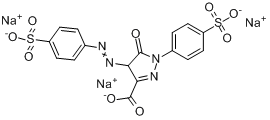
Tartrazine, also designated FD&C Yellow No. 5, Acid Yellow 23, and E 102, is a synthetic anionic azo dye of the pyrazolone class. It is the trisodium salt of 5-hydroxy-1-(4-sulfonatophenyl)-4-(4-sulfonatophenylazo)-1H-pyrazole-3-carboxylic acid, with the molecular formula C₁₆H₉N₄Na₃O₉S₂ and a molecular weight of 534.36 g/mol. The molecule contains two sulfonate groups and a carboxylate group, all in the sodium salt form, which confer exceptionally high aqueous solubility and a strongly negative charge across the accessible pH range. Tartrazine is supplied as an orange-yellow to deep yellow, odorless powder or granule that dissolves readily in water (approximately 20 g/100 mL at 25 °C) and glycerol, but is essentially insoluble in ethanol and oils.
The extended conjugated system, comprising the phenylazopyrazolone chromophore, is responsible for the dye’s intense lemon-yellow color, with a maximum absorption wavelength (λmax) at approximately 425–427 nm in aqueous solution. Tartrazine is hygroscopic and incompatible with strong oxidizing agents. It decomposes above 300 °C rather than melting cleanly, and the reported density of 1.93–2.121 g/cm³ reflects the dense, crystalline nature of the solid. The very low log P (reported between −1.57 and −10.17 depending on the model) confirms negligible lipophilicity and predicts limited partitioning into lipid membranes or fatty food matrices.
Applications
Tartrazine is one of the most widely used synthetic colorants globally, with established regulatory acceptance across food, pharmaceutical, and cosmetic applications.
In food and beverages, Tartrazine provides a stable lemon-yellow to greenish-yellow shade in soft drinks, confectionery, gelatin desserts, ice cream, sauces, dressings, snack seasonings, baked goods, and dairy products. It is designated INS 102 in the Codex system and E 102 in the European Union. In the United States, it is regulated as FD&C Yellow No. 5 and is subject to FDA batch certification before use in any product sold in the US market. The dye is valued for its high chemical and photostability, which preserves color intensity through processing, storage, and retail display.
In pharmaceuticals, Tartrazine is employed as a colorant in tablets, capsules, syrups, and topical preparations. Color-coding of medications improves patient identification and compliance, and reduces the risk of medication errors, particularly in multi-drug regimens. It is also used in cosmetics and personal care products, including hair dyes, decorative cosmetics, and cleaning products, and as a dye for polyamide fibers and a pigment in printing inks. In diagnostic and histological applications, Tartrazine serves as a counterstain and in special staining protocols.
Preparation Method
Tartrazine is manufactured by a two-stage diazotization–azo coupling sequence centered on sulfanilic acid (4-aminobenzenesulfonic acid).
In the first stage, sulfanilic acid is dissolved in aqueous sodium carbonate and cooled, and sodium nitrite is added slowly to generate the diazonium salt under controlled acidic-to-neutral conditions. The diazonium intermediate is maintained at low temperature to preserve its stability before coupling.
In the second stage, the diazonium salt is coupled with 1-(4-sulfophenyl)-3-carboxy-5-pyrazolone (sulfophenyl pyrazolone carboxylic acid) under alkaline conditions. The electron-rich pyrazolone ring undergoes electrophilic substitution at the 4-position, forming the azo linkage that completes the chromophore. The product is isolated as the trisodium salt by salting out with sodium chloride, filtration, and drying. An alternative historical route condenses two molecules of phenylhydrazine-p-sulfonic acid with one molecule of dihydroxytartaric acid, although the diazotization–coupling route is the dominant commercial process. Food-grade material must meet specifications for subsidiary colouring matters, unsulfonated primary aromatic amines, and heavy metals, and the assay is typically expressed as not less than 85% total colouring matters.
Safety Information
Tartrazine carries a GHS Danger classification in many supplier safety data sheets. The harmonized hazard statements commonly reported include H317 (May cause an allergic skin reaction) , H334 (May cause allergy or asthma symptoms or breathing difficulties if inhaled) , H302 (Harmful if swallowed) , and H413 (May cause long lasting harmful effects to aquatic life) . The corresponding hazard categories are Skin Sensitization Category 1, Respiratory Sensitization Category 1, Acute Oral Toxicity Category 4, and Chronic Aquatic Toxicity Category 4. Some assessments also list H315 (Causes skin irritation) and H319 (Causes serious eye irritation) at lower severity levels.
The acceptable daily intake (ADI) established by the Joint FAO/WHO Expert Committee on Food Additives (JECFA) is 0–10 mg/kg body weight per day, increased from the previous 0–7.5 mg/kg bw/day during the 2016 re-evaluation based on a NOAEL of 984 mg/kg bw/day in a chronic rat study. The International Association of Color Manufacturers notes that Tartrazine has been repeatedly evaluated and concluded to be safe for use, and that estimated dietary exposures, including those of children, remain well below the margin of safety. Tartrazine is not classified as carcinogenic in the evaluations cited by industry safety reviews. Individuals with aspirin sensitivity or a history of atopic conditions may be more susceptible to adverse reactions, and labeling requirements in some jurisdictions (e.g., the EU’s “may have an adverse effect on activity and attention in children” warning for certain colors) reflect regulatory risk-management decisions rather than newly established toxicological endpoints.
For safe handling, avoid generating and inhaling dust, and use local exhaust ventilation where powder handling occurs. Wear protective gloves, eye/face protection, and protective clothing appropriate to the handling scale. In case of skin contact, wash with plenty of soap and water; if skin irritation or a rash occurs, seek medical attention (P302+P352, P333+P313). If inhaled and breathing is difficult, remove the person to fresh air and keep comfortable for breathing; if respiratory symptoms occur, seek medical attention immediately (P304+P341, P342+P311). If swallowed and feeling unwell, call a poison center or physician (P301+P312). Store in a tightly closed container in a cool, dry place protected from moisture and strong oxidizers. Spills should be swept or vacuumed with dust suppression and disposed of in accordance with local regulations; release to drains and watercourses should be avoided in line with the H413 precautionary statement where applicable.