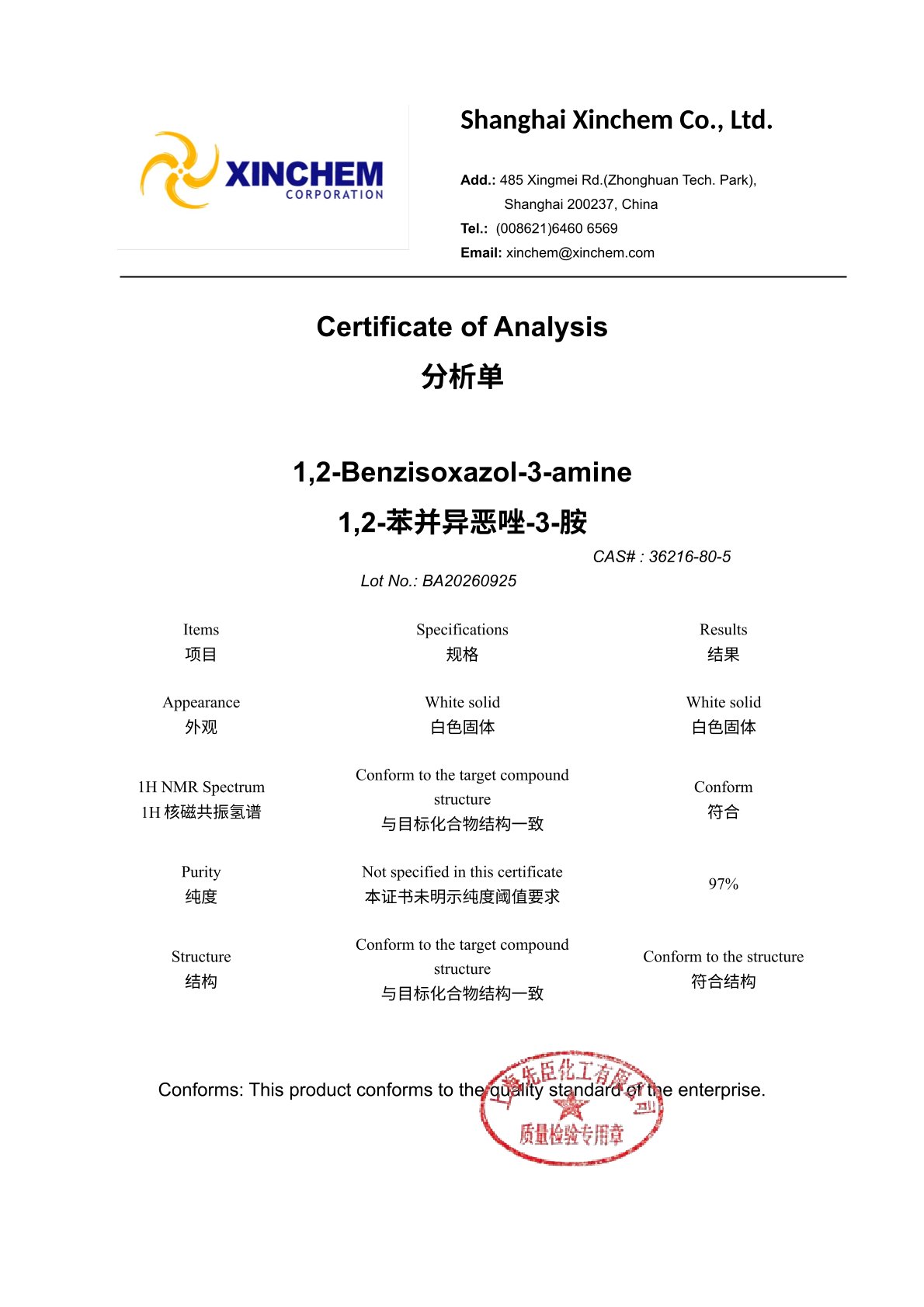


1,2-Benzisoxazol-3-amine (CAS#36216-80-5)
1,2-Benzisoxazol-3-amine, also known as 3-amino-1,2-benzisoxazole or benzo[d]isoxazol-3-amine, is a heterocyclic amine featuring a fused benzene–isoxazole ring system with an amino substituent at the 3-position. It is supplied as a white to off-white solid with a melting point of approximately 108–112 °C. The compound has a molecular weight of 134.14 g/mol and a predicted logP of 0.35, indicating moderate hydrophilicity. It is slightly soluble in dimethyl sulfoxide (DMSO) and methanol, and is hygroscopic in nature. For optimal stability, the product should be stored under an inert atmosphere of nitrogen or argon at 2–8 °C.
The 3-amino group on the benzisoxazole core serves as a versatile synthetic handle, enabling a wide range of transformations including acylation, alkylation, sulfonylation, and diazotization. The fused bicyclic system provides a rigid, planar scaffold that is valuable for the design of biologically active molecules with defined spatial orientation.
Applications
1,2-Benzisoxazol-3-amine is primarily used as a pharmaceutical intermediate and heterocyclic building block in drug discovery and development. Its benzisoxazole scaffold is a privileged structure in medicinal chemistry, frequently employed for the synthesis of enzyme inhibitors and receptor antagonists targeting the central nervous system and other therapeutic areas.
The compound functions as a key synthetic intermediate for the preparation of substituted 3-(aminoalkylamino)-1,2-benzisoxazole derivatives, which have been investigated for their pharmacological activity. It also serves as a molecular fragment for scaffold hopping, fragment expansion, and structural modification, providing a structural foundation for the design and screening of novel drug candidates. Additionally, the compound is utilized in the synthesis of zonisamide-related intermediates and other sulfonamide-based pharmaceutical agents, where the 3-amino group is elaborated into methanesulfonamide or acetic acid functionalities. Its diverse biological activities, including inhibition of various enzymes and receptors, make it a promising candidate for drug development research.
Preparation Method
A widely employed laboratory synthesis of 1,2-Benzisoxazol-3-amine proceeds via a one-pot cyclization between acetohydroxamic acid and 2-fluorobenzonitrile. In a representative procedure, acetohydroxamic acid (10.0 g, 133 mmol) is dissolved in N,N-dimethylformamide (150 mL), and potassium tert-butoxide (14.9 g, 133 mmol) is added. The mixture is stirred at room temperature for 30 minutes to generate the hydroxamate anion, after which 2-fluorobenzonitrile (18.0 g, 133 mmol) is introduced. The reaction is allowed to proceed at room temperature for 5 hours, during which the hydroxamate oxygen undergoes intramolecular cyclization onto the nitrile carbon with concomitant displacement of fluoride, constructing the benzisoxazole ring. Upon completion, the mixture is poured into water and extracted with ethyl acetate; the combined organic layers are washed with water, dried over anhydrous magnesium sulfate, and concentrated under reduced pressure. The residue is recrystallized from hexane to afford the target compound as a solid (4.80 g, 27.0% yield).
An alternative and more rapid approach utilizes microwave-promoted nucleophilic aromatic substitution starting from 3-chloro-1,2-benzisoxazole. The desired amine is added to a solution of the chloro precursor, and the sealed vial is subjected to microwave irradiation for 1–6 hours, delivering the corresponding 3-amino-1,2-benzisoxazoles in 54–90% yield. This method is particularly attractive for the parallel synthesis of structurally diverse 3-amino-substituted benzisoxazole libraries.
Safety Information
1,2-Benzisoxazol-3-amine is classified as an acute oral toxicant (Category 3, H301) and an eye irritant (Category 2, H319), with a GHS signal word of Danger. The compound also causes skin irritation (H315) and may cause respiratory irritation (H335). It is assigned to storage class 6.1C (combustible acute toxic category 3 compounds) and Water Hazard Class 3 (WGK 3), indicating significant hazard to water.
For safe handling, it is essential to avoid breathing dust, vapor, mist, or gas, and to avoid contact with skin and eyes. Personal protective equipment including safety goggles or face shields, protective gloves, and protective clothing is required. Use only in a well-ventilated area or fume hood. In case of eye contact, flush with plenty of water for at least 15 minutes, occasionally lifting the upper and lower eyelids, and seek medical aid. In case of skin contact, flush with plenty of water for at least 15 minutes while removing contaminated clothing and shoes, and obtain medical attention. If inhaled, move the victim to fresh air and keep at rest in a position comfortable for breathing; if not breathing, give artificial respiration and seek medical aid. If swallowed, rinse mouth with water and seek medical attention immediately. In case of fire, use water spray, dry chemical, carbon dioxide, or chemical foam as extinguishing media. Spills should be vacuumed or swept up and placed into a suitable disposal container, avoiding dust generation. Storage should be maintained in a cool, dry, well-ventilated area under inert gas at 2–8 °C, away from incompatible substances.