

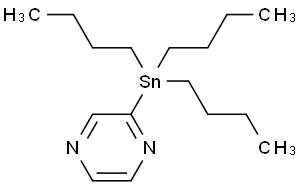
(Tributylstannyl)-pyrazine(CAS#205371-27-3)
| Risk Codes | R20/21/22 - Harmful by inhalation, in contact with skin and if swallowed. R36/37/38 - Irritating to eyes, respiratory system and skin. R50/53 - Very toxic to aquatic organisms, may cause long-term adverse effects in the aquatic environment. R48/23/25 - R36/38 - Irritating to eyes and skin. R25 - Toxic if swallowed R21 - Harmful in contact with skin |
| Safety Description | S26 - In case of contact with eyes, rinse immediately with plenty of water and seek medical advice. S36/37/39 - Wear suitable protective clothing, gloves and eye/face protection. S61 - Avoid release to the environment. Refer to special instructions / safety data sheets. S60 - This material and its container must be disposed of as hazardous waste. S45 - In case of accident or if you feel unwell, seek medical advice immediately (show the label whenever possible.) S35 - This material and its container must be disposed of in a safe way. |
| UN IDs | UN 2788 6.1/PG 2 |
| WGK Germany | 3 |
| HS Code | 29339900 |
| Hazard Note | Toxic |
| Hazard Class | 6.1 |
Introduction
2-(tri-n-butyltin) pyrazine.Quality:2-(trin-butyltin)pyrazine is a colorless or yellowish liquid. It has high solubility and is easily soluble in organic solvents.Use:2-(tri-n-butyltin)pyrazine is widely used as a catalyst in organic synthesis. It can be used to synthesize carbon-carbon and carbon-nitrogen bonds in organic compounds, and has good selectivity and catalytic activity. It is commonly used in catalytic coupling reactions, tandem reactions, reduction reactions and cyclization reactions.Method:2-(tri-n-butyltin)pyrazine can be obtained by reacting the reactant n-butyltin chloride with pyrazine. The reaction is usually carried out in an inert atmosphere and requires an organic solvent as the reaction medium. Other synthetic routes can also be taken to prepare the compound.Safety Information:2-(Tri-n-butyltin)pyrazine is an organotin compound and the relevant safety operating procedures should be followed. When using or operating, it is necessary to wear appropriate personal protective equipment, such as chemical protective gloves, safety glasses, etc. Avoid direct contact with skin or eyes, and avoid inhaling their vapors or dust. Attention should be paid to fire and explosion protection during storage and handling, and contact with oxidants and strong acids should be avoided. In case of accidental ingestion or contact, seek medical attention immediately.
Application
(Tributylstannyl)-pyrazine (2-(Tributylstannyl)pyrazine, CAS 205371-27-3) is a key organotin reagent widely used as a versatile Stille coupling reagent and heterocyclic building block in medicinal and process chemistry. Its reactive Sn–C bond enables efficient palladium-catalyzed cross-coupling with aryl, heteroaryl, and alkenyl halides or triflates to construct complex biaryl and heterobiaryl scaffolds. As a pharmaceutical intermediate, this compound allows the installation of pyrazine motifs into drug candidates targeting oncology, inflammation, kinases and GPCRs. It also supports the synthesis of functional materials, metal–organic frameworks and organic electronics. With high chemical purity and reliable performance, (Tributylstannyl)-pyrazine is an essential tool for C–C bond formation and heterocyclic diversification, enabling rapid structure–activity relationship studies. Xinchem offers custom synthesis, custom chemical synthesis and contract manufacturing of (Tributylstannyl)-pyrazine with flexible scaling from R&D to commercial tons. Contact us today for a competitive quote and reliable global supply.
![1-(2 2-Difluoro-benzo[1 3]dioxol-5-yl)-cyclopropanecarboxylicacid(CAS# 862574-88-7)](https://www.xinchem.com/uploads/122Difluorobenzo13dioxol5ylcyclopropanecarboxylicacid.png)

![6H-Dibenz[c,e][1,2]oxaphosphorin 6-oxide(CAS#35948-25-5)](https://www.xinchem.com/uploads/6H-Dibenzce12oxaphosphorin-6-oxide.gif)